Title is editorialising; actual title is “Change in Antarctic ice shelf area from 2009 to 2019”.
From the abstract:
> Our observations show that Antarctic ice shelves gained 661 Gt of ice mass over the past decade, whereas the steady-state approach would estimate substantial ice loss over the same period, demonstrating the importance of using time-variable calving flux observations to measure change.
The title of an HN submission does not have to match the article's title. It's also not editorializing. It's a factual statement, except it should probably be revised to 661 Gt instead of the 600 Gt quoted (doesn't change substance).
The ice shelves, not all of Antarctica, gained ice.
I guess you could read the HN title and think, "see Antarctica must not be getting warmer if it gained ice." Where the shelves could have gained from the glaciers flowing faster off the land, and amount of ice could still have gone down.
Figure 6. does not show total Antartica ice mass change, it shows a local area change in relative sea level markers.
Today the relative sea level markers are much lower as the land itself is riding higher overall due to glacial rebound, the lifting of the land as a great weight is removed.
Your paper (as discussed in the conclusion) argues that during the past 6,000 years a great deal of ice has been lost, having retreated some 30km and thinned by some 800m in thickness.
Did you make a typo, or did you misunderstand your own linked source material?
> The title of an HN submission does not have to match the article's title.
Actually, it should other than a couple guides on tidying it up. From the guidelines:
> If the title includes the name of the site, please take it out, because the site name will be displayed after the link.
> If the title contains a gratuitous number or number + adjective, we'd appreciate it if you'd crop it. E.g. translate "10 Ways To Do X" to "How To Do X," and "14 Amazing Ys" to "Ys." Exception: when the number is meaningful, e.g. "The 5 Platonic Solids."
> Otherwise please use the original title, unless it is misleading or linkbait; don't editorialize.
In addition to others' comments, I see no reason why "vs. a prediction of a 20k Gt loss" should be a good summary, when (I assume) the number was lifted from:
> whereas the steady-state approach would estimate ice loss of −20 028.1 Gt over the same period
I'm not a climatologist, but for all I know this could mean something like "If we draw a straight line between point A and B it will intersect a point that is 20,000 Gt below the observed value, which is clearly silly, and that's why we should not do that." I see no claim about which research group actually made a prediction of 20k Gt loss, but obviously I didn't read the whole article, so I'll wait for the OP to chime in and explain where in the paper it cites a previous work that made such a prediction.
That's a very unusual choice of start and end dates, almost as if there is an intent to misrepresent the data. Where can I find a good dataset over a wider range?
Here is another way to think about these numbers: Antarctica was predicted to lose 140 cm of ice, but instead gained 4 cm. (This assumes the change of mass of ice would have been spread over the entire 14.2 million km² of the continent.)
Somehow the temperature of the earth is now a political football so any actual facts are hijacked by people with an agenda. Intellectually, I'm scared to touch this subject because it's such a hot potato. (no pun intended)
Like the article from here.. that the Antarctica gain 600Gt of ice.
Some will say that global warming is a scam because of that, some may say it's just a random increase with a long-term trend of decrease due to global warming... and I just like having the data.
This isn't raw data. The raw data is a gigantic pile of satellite measurements. This is all of that data collapsed down into a single figure via a model (itself derived from yet more data), and the scope of that figure isn't as easy to characterize as "Antarctica did X".
So I'd cautioned you against the belief that you really have any data here. You have a single number, flagged for your attention by somebody who (presumably) believes that they can influence your conclusion in a particular direction. You can't really draw conclusions from data without gathering as much data as possible, and this single number is nowhere near complete. If this data strengthens your confidence that you understand the whole situation, then it is worse than having no data at all.
It's frankly just embarrassing too, since the data is obvious, the majority of (actual qualified scientists) who understand the subject agree that global warming is in fact happening, but a small minority of loud voices backed by big corporations make it appear that this is in fact a debatable issue.
Yes this kind of link seems to be very misleading. It is amazing that just because an idea is presented, that it will have so many people believing it. This is a classic example of disinformation seeding. In reality, a casual pub chat like this is not science, not evidence not anything other than the blind leading the blind.
A really great HN article would present multiple papers and deal with technology and science, as well at ethics. This discussion does not do that.
Announcing your theory that fractions don't exist or that pi is 3 would also be career suicide in math. That doesn't mean that mathematicians are overbearing dogmatics. Some ice forming somewhere in Antarctica is a fine observation. It's not a contradiction to global warming. Local ice forming or local temperature drops aren't evidence against it.
If climate scientists do dare to contradict the consensus around global warming, they have a high burden of proof. Stirring the pot by contradicting consensus without meeting that burden of proof is really earning the career suicide that you say follows, whether or not they believe what they're claiming. If done with intent to mislead, that would seem to put you with all the scoundrels who have taken a paycheck to lie to the public about lung cancer from cigarettes, and then later took paychecks to lie to the public about AGW.
The climate is extremely complicated. Measuring “average” earth temperature is itself open to interpretation. We have evidence that the earth was much cooler in the recent past as well as much hotter. Carbon PPM doesn’t necessarily cause the increased temperatures we are perhaps having.
To say any of this publicly as a professor is career suicide. To say it as an employee is to be labeled a corporate stooge. The only solution according to the government is to hand trillions of dollars to ESG whatever the fuck and don’t look too deeply at how it’s spent. Insanity all around.
> We have evidence that the earth was much cooler in the recent past as well as much hotter.
Whatever "recent" is to you, there are graphs comprised of plenty of good data which very strongly support the theory that industrialization by humans and the associated, rapid increase of CO2 have lead to increased retention of solar energy and all the effects that come with that.
There's also not really any doubt that raising atmospheric CO2 increases energy retention through reduced emission to space. It's something that can be modeled well.
> To say any of this publicly as a professor is career suicide.
Not true. I happen to know of a community college professor in a rural area who is popular with some people because he is skeptical of global warming... He's unqualified to be in front of a class talking about it, but some people like and encourage that sort of thing.
The fact remains that the oil lobby has paid big bucks to convince people AGW isn't a thing, while at the same time believing it was.
I think most of the skepticism pointed at the fundamental idea of AGW is a side effect of that propaganda, or more of the same.
One of our best family friends is a PhD in meteorology and her graduate research was on aggregating temperature data collected from global weather stations.
In her own words, the data was shit and full of gaps, she wasn’t a software engineer yet self-taught the necessary python to create horrible kludge scripts that turned it into “something”, and was given a grant from the NIH for her work.
The end result was a single vector trumpeted by her ivy-league school that added “yet more evidence” to the consensus of climate change, and she is now a tenured professor in the UC system. Total garbage end to end.
I love her to death but get her a few cocktails deep and she will freely admit it’s a grift.
I’m not saying climate change is incorrect, but I will say that the “overwhelming consensus” has resulted in a lot of warped incentives and weird results. The climate is really hard to model and in a rush to blame it for the apocalypse we have reduced a lot of critical thinking.
It’s because you only get published and therefore funded if you can make a claim that generates power. Money and influence will and does flow to things that will require change. The more dramatic the better.
No one is going to fund research that concludes things will be ok. That’s a snooze fest. Only things that suggest we “DO SOMETHING”, which means justify power, get the attention from the people that want to continue justifying power.
It’s why everything is a “crisis” today. There’s limited funding and finite seats at the table and you better believe the ideas that are “urgent” are the ones that will get funded. It’s not a coincidence these ideas also generate power.
Large scale well curated Ocean tempreture datasets originated from the Cold War days from a desire to be able to pinpoint submarine movements heard via sound travelling along thermoclines.
Atmospheric gas libraries originated from the same era in order to track the changes resulting from atmospheric nuclear tests ( ~800+ IIRC ).
Both these data sets were funding by the military with desire to prove climate change etc. although they did hide under the cover of ocean research | environmental research.
Other datasets come from global mineral and energy exploration geophysics, again these have goals far removed from climate change - you're correct that they are motivated by the desire for 'power' via mapping resources and extracting them.
I think you’re entering tinfoil hat territory here.
Catastrophic climate doomers will get more clicks/citations/panels than moderates than skeptics.
“The world is ending we must act now” is a whole lot more attractive than “there are concerns but they are manageable” which is more attractive than “climatology isn’t actually science because it isn’t falsifiable and there’s a lot of contradicting models built by equally qualified people and we should avoid only listening to the most dramatic ones and try and do actual science when possible and be wary of dogma.” No one’s funding that for more research!
I've worked four decades in exploration geophysics on global scale surveys of entire countries and I've met a number of my predecessors that worked on ocean tempreture data aquisition and atmospheric sampling.
The larger data aquisition surveys are not undertaken at the behest of "Catastrophic climate doomers" - they are funded by deep pockets that can sustain a burn rate of often a million+ USD per day (sub sea seismic modelling, satellite constellations, etc).
The data aquired shows that global climate is changing in a manner consistent with the physics first discussed a century ago.
This would partially explain why sea level didnt rise up. But then again, reading the comments, seems like a lot not that happy with this piece of article. Maybe not conforming to current narrative?
Except sea levels did "rise up" as you say, faster than expected actually. This article is about the ice shelf, i.e. the ice over the sea - not the ice over land. People expected the shelf to break and go to sea, and from there currents would take it to warmer water. Turns out the shelf is able to extend further than was thought possible.
Despite this I’m sure there’s a counterintuitive reason as to why this is actually bad, far worse even than the 20k Gt loss scenario. Can anyone explain?
The headline overstates things. It's not a prediction of a loss, just a different way of measuring:
To compare the different methods, we calculated the difference between the two numbers on all ice shelves within the study. We observed mass loss on 18 ice shelves and mass gain on 16. Overall, the steady-state assumption will overestimate ice loss on ice shelves that are advancing and underestimate ice loss on ice shelves that are retreating. The assumption also does not hold well for any irregular behaviour, such as ice shelves that have lost ice through large calving events. Our observations show that Antarctic ice shelves gained 660.6 Gt of ice mass from 2009 to 2019, whereas the steady-state approach would estimate ice loss of −20 028.1 Gt over the same period (Table 1).
The steady-state prediction is an approximation and is described in the article:
In the absence of an observed measurement of ice loss from iceberg calving, previous studies have used the steady-state calving approximation to estimate the volume of ice lost through calving processes (Rignot et al., 2013; Depoorter et al., 2013). This method assumes that all ice flow through a fixed flux gate, usually located near or at the last known calving front position, is lost through iceberg calving.
The shelves float out over the sea .. and largely (not all) source from "main" ice mass which is much much (magnitudes) larger.
The shelves (ice floating out on the fringes) "growing" can indicate more main mass flowing in from behind the shelf than is being calved and lost from the front of the shelf.
ie. This could indicate greater ice mass loss and flow out from the core and accelerated Antarctica melt down.
Overall this is a "bastard" problem in geophysics - to measure the South Pole ice mass "all you have to do" is measure the volume between the ice surface and the ground underneath then add in the shelves.
However, large ice mass loss in an area can (and does) result in the ground underneath rising up .. and it takes a great deal of fuel and energy to fly the kinds of ice penetrating radar grids required to continuously track the ice surface and ice floor.
There are other complications, but this is not as straightforward as armchair forum experts imagine.
Not everything has to be bad, or a set up for something worse to happen. Sometimes, even when there is an overall line with negative m, good things can happen.
Maybe a climatologist will stop by and be interested in a fight.
I am not, and cannot explain why this is "far worse".
But I can explain why it's common sense to me as a random non-scientist (not a climate "doomer" or activist either) that it shouldn't change opinions about climate change in general.
1. The HN title may be deceptive - this appears to be about sea ice. A cursory look around suggests to me that conventional wisdom has been that Antarctic sea ice has not shown a trend over a few decades, while the land ice seems to be declining (and Arctic sea ice has been declining).
2. Conventional wisdom appears to be that most of the sea ice is seasonal. 600 Gt sounds like a lot in an absolute sense, but it's only 3% of 20K and minute compared to the seasonal change or the entire amount. Practically speaking, as far as I can tell, 600 Gt is equal to zero. And this would presumably be consistent with others saying that there has been no trend.
3. Finally, I've never seen anyone even try to make a case that an increasing greenhouse effect must have perfectly uniform effects. I don't think this is a matter of climatology, but of understanding what a mean or average is and that there's no uniform baseline to start from. It seems like a common sense mathematical fact to me, regardless of climatology, that if the earth warmed up by a few degrees, the temperature profile over different latitudes could become steeper or shallower. Everybody knows that the continents are not uniformly distributed, so why would you be skeptical of a difference between climate change at the poles, either?
I feel like both people arguing against addressing climate change and people arguing for it tend to drift away from the idea that it is governed by global mechanisms.
There are no borders stopping greenhouse gases, right?
People can make dubious arguments about local problems and extreme weather that may seem weak to others, but the bottom line is that scientists observe CO2 levels as well as other things, that keep going up. And on average, until that changes, stuff will keep happening more and more. Media clickbait can't change that.
I've seen submissions to HN about global emissions decelerating or hopefully levelling off, and that's where my skepticism kicks in. Emissions figures are just accounting, and accounting is fallible.
As far as I know, any progress in official emissions figures is contradicted by simply measuring the atmosphere, but I would really like to know if I'm incorrect about that.
It's disturbing to me to think that (a) global warming/climate change is real and proceeding unchecked with huge consequences and that (b) people who claim to be concerned are all pretending.
But I haven't yet figured out an alternative to believing those things.
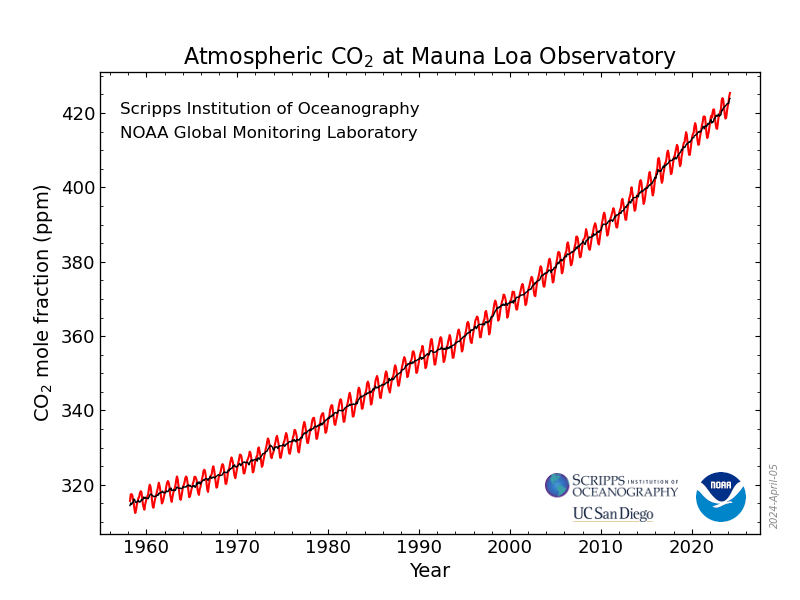
Here is the crux of it - CO2 levels observed in Hawaii, which is physically isolated and has had observations for a long time:
If there is an argument that it takes X amount of time before reduced emissions show up in that trendline, I would like to know what X is. Or how, probabilistically, it could be determined if emissions figures are likely BS.
I tried asking ChatGPT (the original free version) with a nearly 200 word prompt, and it provided 4 paras of boilerplate on the topic, but entirely missed what I was asking and wasn't terribly internally consistent either.


From the abstract:
> Our observations show that Antarctic ice shelves gained 661 Gt of ice mass over the past decade, whereas the steady-state approach would estimate substantial ice loss over the same period, demonstrating the importance of using time-variable calving flux observations to measure change.