I've had Vitamin D deficiency from the child and I suffer from Achondroplasia(not diagnosed until recently). I've had ilizarov fixations twice during childhood to fix the bow legs and I had explicit medication for Vitamin -D only when I was teen for couple of years.
But after 15 years, I nearly ended-up becoming a Quadriplegic[1] and I was told my bone condition was like that of 80 year old (I was 32). For the past 2 years I've had single Zoledronic acid injection each year to treat the osteoporosis along with monthly Vitamin D3-Cholecalciferol 60K IU, recent tests showed that there has been about ~ 10% improvement in bone density at some areas and few areas have become worse.
I often wonder if whether I had been put through proper Vitamin D supplement from childhood, the situation would have turned out this bad.
Anyways, Vitamin D seems like the new Yoga and everything from memory to COVID prevention is being attributed to it; but I can say one thing for sure from my experience - If your Vitamin D is low, take proper medication on doctor's advice and follow it up regularly as bone diseases don't come with warning unlike other organs in our body.
No disrespect intended, I am biologically challenged, but I do not understand how anyone can have a Vitamin D deficiency when 15 minutes of sunlight a day on the skin creates all the Vitamin D anyone needs, and too much Vitamin D is very bad. I suppose it makes sense in the Winter months when everyone is inside for months, but usually, the sun shines every day, even in Winter.
I have discussed at length regarding this with endocrinologists.
There is no shortage for the source of Vitamin D - As you mentioned - UV from Sun, certain food and of course supplements. But the destination should be able to activate it. So, in my case my body is not able to activate the Vitamin D in the system properly and so is the case with most Vitamin-D deficient people.
>Vitamin D obtained from sun exposure, food, and supplements is biologically inert and must undergo two hydroxylations in the body for activation. The first occurs in the liver and converts vitamin D to 25-hydroxyvitamin D [25(OH)D], also known as calcidiol. The second occurs primarily in the kidney and forms the physiologically active 1,25-dihydroxyvitamin D [1,25(OH)2D], also known as calcitriol[1].
Further, Vitamin D is necessary for calcium absorption in the gut. Hence, the lack of Vitamin D causes bone problems among other issues.
Latitude matters. The farther north you are the more time in the sun you’d need. In some far north places, the sun you do get is not strong enough to get any Vit D.
Not everyone can afford getting half naked under the sun on a daily basis.
It's easier to be deficient than you think. Do a blood test. You may get an unpleasant surprise.
I think about half of the population is either insufficient or deficient without supplementation.
It really depends on what counts as insufficient. There is enough debate in the scientific literature on what constitutes a "sufficient" level of Vit D for most healthy adults. If we set the sufficiency level of 25(OH)D of 20 ng/mL (50 nmol/L), most of the world's adult population would be in the healthy range. These levels can be achieved in a healthy Caucasian adult in a northern latitude in summer (eg, Edinburgh, Scotland) with as little as, say, two sessions of 10 minutes each in a week, exposing just the arms and legs.
Serum levels of Vitamin D also do not plummet with the winter months - it's more of a slow dip, and the seasonal low levels do not seem to negatively effect most adults.
Even during the nicest weather of the year, I don't typically spend 15+ minutes outside every single day, and even when I am outside, only my arms below the elbow and face are exposed.
It simply does not follow from "the sun shines" that "everyone basks in it all the time".
> usually, the sun shines every day, even in Winter.
Not in Vancouver!
And even on the few sunny winter days, the full daylight hours might typically be spent in an office. Even the commute happens in the dark.
I'm from South India and I know two people in my family with severe Vitamin D deficiency. Sunlight-> Vitamin D won't happen for most people with a white collar job even if you are near equator. Hospitals in India rarely offer that test as it's expensive. We insisted on getting one after severe back pain and other symptoms.
I've seen studies that show quite low levels of Vitamin D in even healthy rural south Indian farm workers. The average was ~ 20 ng/mL. The study authors speculate that the high levels of phytates in the typical Indian diet might be to blame.
I've seen that claim given as "15 minutes of full body exposure to noonday sun", which is obviously quite different from what most of us might get. Also I expect it depends on your skin tone. If anyone could dig up the original source for the 15 minutes claim I would be curious (tried a bit but have to get back to work).
Low magnesium impairs vitamin D activity and levels. Same occurs as a result of declining hGH/IGF-1 with age. Further, cholesterol within skin diminishes with age (and cortisol rises) lessening response to sunlight.
The further north, the less days of direct sunlight. Exposure would have to also be all over, but most are covered by clothing.
Thanks, Several others(not doctors) have recommended this as well, but my potassium levels were fine in the test results. There is an in-depth blood profiling regarding my bone health planned next year, I'm planning to find out more about the role of K2 and Boron and whether it affects me before that.
There is a a group of vitamins marked K, among them K1 and K2 (with various forms such as MK4 and MK7).
There is NO relation between those too, except the coincidence in using the same letter. What you want w.r.t to bone health is specifically Vitamin K2, not K1, and not the mineral K (a.k.a Potassium).
(This is similar to vitamin C having no particular relation to element C, a.k.a Carbon).
If I may add please look into harmala alkaloids specifically harmine to aid in bone density . It is completely unregulated in the USA and the doses required to achieve a proper response isn't high enough to cause nausea or other effects . Dosing twice a day is good enough .
But as always do you own research and read up on contradictions . I recall reading this many years ago because if its effects on DYRK1A
Although I'm not currently planning to try any self-medication, I will study about Harmala alkaloids to learn about its significance with bone density. Thank you.
The author explains the following, regarding Vitamin D studies:
> Most studies follow this pattern: Two sets of people are evaluated. One set has a certain disease (diabetes, for example). The other set does not have the disease. Vitamin D levels are measured in both groups. Vitamin D deficiency is found to be much more common in the group of diseased individuals.
If this is true, I wonder if most studies aren’t falling short for failing to control for Vitamin D deficiency. Couldn’t the studies be structured differently?
Let’s say we want to know the effects of Vitamin D on Covid. What if, instead of measuring Vitamin D deficiency in a group with the malady and a group without (analogous to what the author suggests most studies do):
We had two groups made up of Vitamin D deficient people. We gave the first group a Vitamin D supplement and the other a placebo. We then observed both groups out in the wild (ideally a place with a high R), measuring for infections. If the supplement folks were infected at significantly lower rates than placebo folks, wouldn’t this be better at demonstrating causation?
A quasi-fix could be to control for the most obvious sources of vitamin D: how often do you go outside, how long do you go outside, do you take vitamin D supplements, how often and with which strength. You can do this kind of analysis alongside any type of study, don't need full coverage and get some preliminary results. All you need is a Bayesian on your team (: partially in jest) or the willingness to open up your data after you publish.
In my opinion as someone who practices non-medical statistics the trope of correlation vs. causation and interventional vs. observational are somewhat overblown. Andrew Gelman posted somewhat snarky about MDs and statistics recently [1]. I see that this post is in (very) good faith, but it does have the MD-bias to statistics in it.
I'm the one who wrote the blog, and really appreciate your comment. As a physician, I can confirm that most physicians have only the tiniest grasp on statistics - and most will not have even heard about Bayesian stats.
I do not want to imply that observational studies of correlation are useless - or even that observational studies are "less valid" than randomized controlled trials (something that doctors usually assume, but it incorrect). I actually want to write about this issue in future posts. There is a lot I want to cover, and stats in medicine is one of my favorite topics. One blog at a time, though.
I'm looking forward to future posts as well! Thanks for writing this. You gave me pause to reconsider the only supplement I give my children and perhaps even more so in future episodes.
In slovenia, most of the deaths are in old-age/nursing homes, where most of the patients have severe health issues and a lot of them are bed-bound. Yes, they have lower vitamin D, but also many other health problem, so looking at a single variable (vitamin D) proves corellation but can't prove any causation without interfering (eg. giving half of them vitamin D supplements, to compare to the other half).
Great point. Low Vitamin D is common in very sick people, partly because they are not as active, not going outside, and may not be eating the best diets. There are trials like you describe, which I'm hoping to get to in part 2... or 3? There is a ton of information to cover!
I love this Spurious Correlations site. And you are correct - a correlation can be a first-filter, especially if you have some reason to believe that there would be a causative connection. And though "correlation does not equal causation" is a cliche, it is still so easy to get sucked into equating the two. Part of the human brain's desire to make sense of things.
Do you mean failing to control for the disease causing vitamin D deficiency? Because it seems that's the issue you're addressing with your proposed study design.
Two axis of engineering problem definition not handled by the article are definition of normal and lifestyle variation.
The concept of normal blood chemistry levels is vary vague. Certainly for mariners over 200 years ago the level of vitamin C was always normally very low. Running a nutrition program for Columbus-era mariners to optimize their diet to produce the most numerically average possible vit-C level would be possible but would not be healthy at all. There's a giant subculture of both doctors and average people running all kinds of semi-long term experiments on diet and health. Another side dish is the definition of normal for diet, some consider paleo to be normal diet and some consider twinkies and hot pockets to be normal diet. And of course that "normal" diet interacts in peculiar combination with "normal" concept of blood chemistry making it a very complicated problem.
The lifestyle issue is an interesting problem. Due to local weather I don't go outside and due to exercise hobbies I'm extremely large from weight lifting for many years, also I sweat out a ton of electrolytes and presumably water soluble vitamins every other day. A stereotypical elderly petite sedentary zero-exercise desk worker would likely turn into a pillar of salt if they consumed the same salts I require to prevent muscle cramps, but perhaps this theoretical person is old enough to still falsely consider sun tanning as a healthy activity. Meanwhile our evolutionary ancestors evolved to work as physically hard as me yet do it all out in the sunlight naked. Given this incredible diversity in lifestyle, you'd think we'd all take different vitamin/supplements much like we drink varying amounts of water, perhaps a 5 to 1 ratio of individual variation if not more, but instead the bottle of vit D pills in front of me claims we should all take 125 mcg aka 5000 IU which is 625% of the normal RDA. That seems highly unrealistic.
I'm sure there's potential startup ideas to both gather data and analyze the data. Rather than running a trial on 322 people and hoping its good enough, you could gather less accurate data from 1e6 people, maybe 1e7 people, using some kind of cloudy app statistical sampling thingie.
There's a lot more to this author that the average poster. Deva Boone was commenting in this thread [1], she's a doctor. Seems sensible and makes interesting points. She was posting under https://news.ycombinator.com/user?id=devaboone. Just posting this because there's always kind of wacky things said about the miracle of vitamin D and I was interested in what an actual doc has to say (as opposed to us programmers ;-)).
Interesting that she never mentions the effects of sunlight on Vitamin D levels. I know she has talked about it in other threads on HN, but not in this article.
Hi, I'm the one who wrote the blog post. Thanks for commenting. Sunlight is important. There are a lot of things that are also important that aren't in the blog, simply because I couldn't cover all of them and keep the post to a manageable size. I like reading these comments to find out what people want to know, though, and what I should cover in the next post. Sunlight will be addressed.
I recall reading a few years ago about an (Australian?) study That found that the non-bone health benefits correlated with Vitamin D were equally correlated with sun exposure. I’d be interested to know if any more research has been done on this.
One thing I’d be interested to know: do we know anything of differing outcomes based on source of vitamin D. I.e sun vs. vitamin D lamp (e.g. sperti) vs. diet vs. supplement.
There was a lot of interest last time on this topic in a previous hacker news discussion [1] so posting this article by my wife (the parathyroid surgeon) here. If you have any questions feel free to post them here and she will check in.
Will do, she set it up on Wix herself to learn a little about how to do all of this. I'm surprised they don't offer an RSS feed, I'll help her out with that.
Thanks for sharing. I skimmed the article looking for a specific set of info but may have missed it: how do bodies naturally/organically generate vitamin D and can that be sufficient or are supplements necessary? (E.g. I surf 5 days a week with sunscreen and go for walks regularly. Will I have enough vitamin D or should I supplement?)
Also, depending on your level of sun exposure and possible deficiency, you should probably supplement MUCH more than what has been usual for decades.
You will find a max of 1000 IU and many supplements at daily doses way lower than that (300 - 700 IU). This is likely wrong:
"Since all-disease mortality is reduced to 1.0 with serum vitamin D levels ≥100 nmol/L, we call public health authorities to consider designating as the RDA at least three-fourths of the levels proposed by the Endocrine Society Expert Committee as safe upper tolerable daily intake doses. This could lead to a recommendation of 1000 IU for children <1 year on enriched formula and 1500 IU for breastfed children older than 6 months, 3000 IU for children >1 year of age, and around 8000 IU for young adults and thereafter. Actions are urgently needed to protect the global population from vitamin D deficiency." [1]
Some of this really depends on where you live, how well you reapply sunscreen, and things like this.
I wound up at the doctor a couple years ago and my levels were really low. For some background, I'm from Indiana and moved to Norway. I got levels up, and was instructed to supplement from September through May. During the summer, I was told I could go outside for a minimum of 15 minutes a day so long as I had enough exposed skin - more than just my face. During the winter, there simply isn't enough sun.
Folks in other locations get different advice. It might change where you are at and with your current activity levels. Surfing may or may not give your skin enough exposure to the sun, depending on your suit. I'd suggest simply going to the doctor and getting levels tested if it worries you.
Try to eat salmon every other day during the winter months. There are other foods, but not that many. Personally, I love salmon, but if you hate fish then milk and eggs is really the only other option unless you want to supplement daily.
Seriously, I'll just follow the doctor's advice, thanks. Changing from supplements is seriously not worth the health risks for me (I found out since then that I have MS, and it is important not to get low).
I'm in Norway, and fish is everywhere. I do eat it, but am mostly vegetarian. I do eat eggs and dairy quite often. It isn't enough: And it isn't just me, but many Norwegians have to take a supplement even though people will teach kids to eat plenty of fish for health reasons. Heck, as an immigrant, we were advised to take supplements during the winter since daylight is not only short in duration but also in intensity - I just didn't follow it at first. I'm lucky to be living in a time when I can take chewable tablets - cod liver oil is more traditional.
Does it matter if the salmon is canned? Right before the lockdown my wife bought something like 50 cans of wild caught canned salmon from Costco and I'd love a good reason to convince my family to eat it all now. Sounds like salmon patties of egg + salmon fried up might be a vitamin D superfood.
I'm not a doctor but I've read a few articles on vitamin D.
> how do bodies naturally/organically generate vitamin D
Avoiding the biochemistry details, vitamin D is produced exposing skin to 280-315 nm (short UVB) radiation [1].
> I surf 5 days a week with sunscreen and go for walks regularly. Will I have enough vitamin D or should I supplement?
The UV radiation depends on [1]:
   Seasons
   Time of the day
   Latitude
   Altitude
   Ozone
   Aerosol and pollution
The production of Vitamin D depends on physiological factors such [2]:
    Age
    Skin type
    Fat absorption
    Obesity
And, of course, the amount of exposed skin and sun sunscreen usage.
According to [2], the required time for a fair skinned Australian achieve "synthesis of 1000 IU of vitamin D with one side of the hands, arms and neck (11% of the body) exposed to the sun (0.455 MED)" on winter at a few AUS cities:
    Darwin: 8 min
    Townsville: 11 min
    Brisbane: 17 min
    Perth: 17 min
    Sidney: 9 min
    Adelaide: 32 min
    Melbourne 43 min
For more details check [2].
A note about sunscreen:
The most common screening agent and their attenuation/absorbance spectrum can be seen on [3, 4]. Note: Only a few of them absorbs UVA radiation, and most of them have downside:
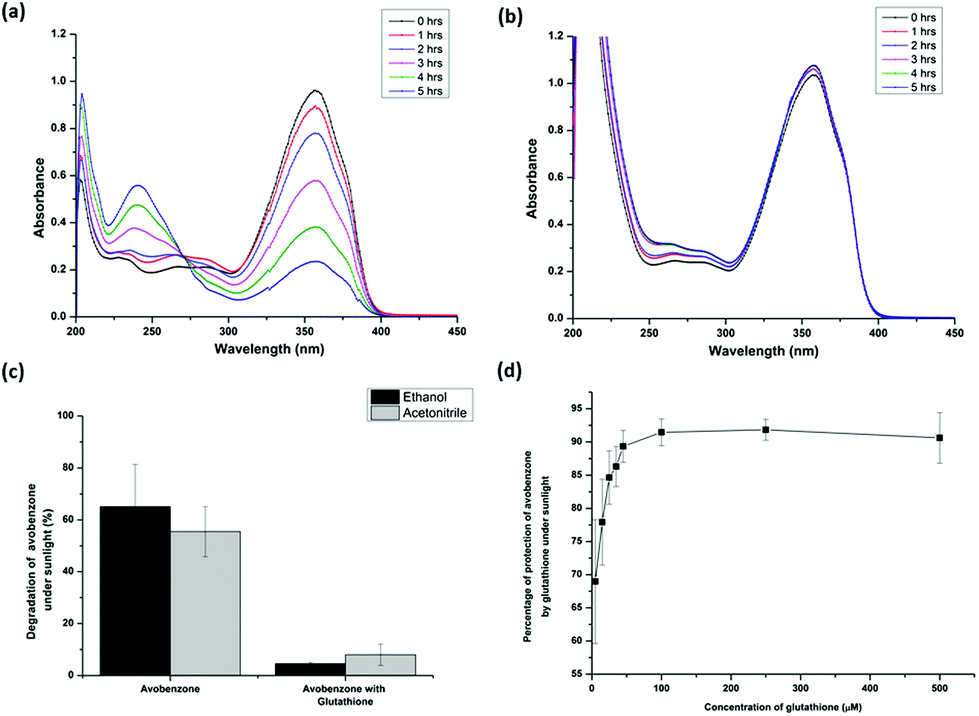
- Avobenzone: is not photostable, it degrades when exposed to the sun. Figure [5 Fig.3 a] compares the degradation with and without glutatione to stabilize (note: glu has a sulfurs smells and is expensive). Another alternative is ubiquinone [6] (also expensive). In pratice they are stabilized with octocrylene and bemo-trizinol.
- Menthyl anthranilate: Wikipedia article has one line. Found only 2 products with this sunscreen.
- Oxybenzone: Banned in few place. It is "detected in nearly every American", "Weak estrogen, moderate anti-androgen; associated with altered birth weight in human studies" [7].
- Zn/Ti Oxide: White cast. Nano sized particle can harm marine life [8], offer poor UVA protection [9] and can cause lung damage when inhaled [9].
In summary. Sunscreen works better at blocking the spectrum needed to produce vitamin D (UVB) than the spectrum that penetrate deeper and does most DNA damage (UVA).
I've been looking for an UVA blocker. But with no luck. I might get one of from a compounding pharmacy, but I reckon an commercial product would have better quality and price.
>Avoiding the biochemistry details, vitamin D is produced exposing skin to 280-315 nm (short UVB) radiation.
Could we then just have a bracelet that had a diode that emits that specific wavelength of light and that way have our body constantly produce vitamin D?
The UVB radiation also does DNA damage, causes redness and tans. Exposing a small area to large cumulative radiation doesn't sound like a good idea. I don't know if this would be physiological possible.
But you are onto something. Since we spend most of the day inside, maybe installing a DLP projector* with UVB light over the monitor could provide an optimal amount of radiation. The DLP could be used to avoid the eye area.
I guess if we had light bulbs that emited that light it could provide the normal amount of exposure that's needed, or even adjustable to suit your needs, quite in interesting idea indeed!
I'm not a doctor, but my doctor told me when I asked that excess Vitamin D passes through your body harmlessly, so there's basically no reason not to supplement if you're worried you aren't getting enough.
According to the comment thread involving devaboone Vitamin D toxicity isn't inherently due to the Vitamin D, but the impact that it has on blood calcium levels.
Thanks. What are your (or Devas) thoughts on the ritual vitamin company's products (http://ritual.com)? They seem like the most researched multivitamin product I've seen but still never gotten an unbiased opinion!
> Vitamin D is a big deal. Recent studies have shown that patients with low Vitamin D levels are more likely to die from Covid-19 than their Vitamin D-rich counterparts,(1) and deficiency in the vitamin has been linked to seven of the ten leading causes of death in the U.S.(2)
1,500 or so words about Vitamin D, but not a single mention of UV?
Can the correlation between COVID-19 mortality and lack of Vitamin D be explained by lack of exercise and/or exposure to UV?
In other words, maybe Vitamin D levels have nothing to do with the disease. It's just a marker for inactivity, which is the real culprit.
If true, this explanation suggests that pumping people full of Vitamin D in the hope they'll fare better with certain diseases would be about as useful as force-relocating the homeless to Beverly Hills. Correlation, not causation.
The paper cited by the author (1) doesn't consider this possibility, either.
One of the mechanisms proposed in recent years to account for Vit D correlations, but not causations, is that Ultraviolet A (from sun exposure), also helps produce nitric oxide (NB, this is also a very good reason to be a nose breather, as this is a major source of your NO).
This won't account for everything either, but we're now fairly sure that the sun exposure -> VitD -> disease link is not as straight forward, and that VitD supps are not necessarily an answer to the low VitD correlations.
I believe the only VitD supplementation causative link we have strong evidence for is to preventing/treating rickets.
i was reading another thread where people were saying homeless and surfers, people who spend a lot of time outside, often have low vitamin D when they get tested. I have NO idea how true that is, but might be an interesting data point.
Being outdoors isn't the same as sun exposure though. In particular, I can imagine that homeless people cover up more to prevent sunburn. Additionally, just being homeless might cause a depletion of vitamin D.
In general, I can imagine that people who spend a lot of time outdoors could get very little sun exposure since they would be more cognizant of the effects of the sun and more likely to wear sunscreen and protective clothing.
That's easy. Crappy diet and alcoholism. Something like 68% of single adult homeless credit substance abuse with their homelessness[1], with alcohol being the most commonly abused substance. Alcoholism and vitamin D deficiency has definitely been linked.[2]
I can't vouch for the veracity of this claim, but I once read somewhere that it takes a while for the vitamin D, which is apparently created in the upper layers of the skin, to work its way down into the bloodstream, and that if you spend a lot of time in the water, it doesn't make it through. Maybe because being wet a lot tends to dehydrate the skin? I don't know.
How much skin is exposed when wearing a wet suit? There's your answer. Just depends on whether the study took place in California (which has chilly water) or Hawaii (which doesn't).
I have literally no educational background about any of this, yet this was so well-written that I was able to understand most of it with hardly any cognitive work or re-reading.
This only confirms my belief that informative writing should be written for the least knowledgeable person regardless of the assumed audience, and if anybody thinks you’re stupid for not understanding their informative writing, then that person is a jerk and should learn how to write better.
Thank you! I wrote the blog post, and my goal was to make it so that someone without any medical background could understand it. By the time I finished, I wasn't sure if I had accomplished that. The article is still pretty dense with medical science. So glad you commented.
+1, I've heard so much about vitamin D in recent months (and even started taking supplementation myself)... this was super well written and informative. Can't wait for part 2 - please post to HN again!
For a review of many vitamin D studies google "site:theincidentaleconomist.com vitamin d", a blog by a doctor who evaluates many studies. Many do not show extra vitamin D beneficial.
Blog quoute: " The IOM says that anything over 20 ng/mL is “Generally considered adequate for bone and overall health in healthy individuals” and when you get over 50 ng/mL “Emerging evidence links potential adverse effects to such high levels”.
I do not understand why we keep looking for Vitamin D to be some sort of wonder drug. It’s seriously baffling to me."
So we need some,>20ng/ml but keep it under 50 ng/ml.
Correlation may not be causation, but it does provide a null hypothesis to fire at. And people with adequate vitamin D seem to die less (https://www.mayoclinicproceedings.org/article/S0025-6196(18)...). Hence the conclusion in this paper (which does have dosages in it).
"The bottom line is that there is no downside to increasing our intake of vitamin D to maintain serum 25(OH)D at at least 30 ng/mL (75 nmol/L), and preferably at
40–60 ng/mL (100–150 nmol/L) to achieve optimal overall health benefits of vitamin D."
This is a good point. And I do want to get to more of the studies done in humans. Although I haven't discussed dosages yet, my advice on everything in life is pretty much: everything in moderation.
I was pretty excited about vitamin D for cancer prevention. I though it might explain higher cancer prevalence further away from the equator. But then Mendelian randomisation studies showed it made no difference. Having said that there was a large randomised trial (VITAL) with some trends towards reduced cancer burden. Only if BMI was normal however, which is highly salient of itself.
I should wait for the next parts, but I fear the author ignores our very important point of view: we are bayesian machines working with limited information under conditions of bounded rationality.
Lack of proof that Vitamin D supplementation is necessary is irrelevant. We don't work on proofs. If I were to describe our standard, it would a balance of "might it help?" and "might it hurt?". Currently, and I think taking the next parts in consideration as well, I think the answers will be very much in favor of supplementation - with caveats I'm actually very eager to read about.
Thanks for commenting! I wrote the blog, and I like your point of view. There was only so much I could cover in one post, but I do hope to get to these issues. And you are right, for most people the conclusion will likely be that a moderate dose of Vitamin D is not likely to harm, and may help - but then there are many many arguments over what constitutes a moderate dose, and I hope to cover that as well.
> Obesity, for example, is a known risk factor for diabetes, and people who are obese also tend to have low Vitamin D levels, due mostly to the dilution of the fat-soluble vitamin in the larger mass of adipose tissue.
I didn't know this. I'm hoping that Part II addresses the long-term Vitamin D storage mechanism. Logically, since sun derived Vitamin D is accumulated during the summer and depleted during the winter, extra storage capacity might be beneficial. This is one area of research where the seasonal cycles are critical. Latitude and the date that samples are collected should be part of the dataset.
Since diet and lifestyle seems to be involved, I wonder how much the phytate [1] content of the starchy staples we consume contributes to Calcium/Magnesium imbalances:
> The (myo) phytate anion is a colorless species that has significant nutritional role as the principal storage form of phosphorus in many plant tissues, especially bran and seeds. It is also present in many legumes, cereals, and grains. Phytic acid and phytate have a strong binding affinity to the dietary minerals, calcium, iron, and zinc, inhibiting their absorption.
It would be ironic if white rice and white bread become recommended over high fiber options. I wonder if the detrimental effects of phytates only apply during digestion, suggesting that some foods shouldn't be mixed in the same meal, or whether the binding affinity is something that occurs in aggregate independent of ingestion time.
A lot of words on correlation != causation without noting any of the causal evidence. Even my 1-pager highlights the obvious responses to this over-used inequality:
1. RCTs show D supplements effective against respiratory infection (Martineau BMJ'17: 25 RCTs, now updated as preprint expanded to ~40RCTs covering ~30,000 people.
2. Causal evidence D is protective against lung injury (in rats) related to ACE2.
3. D extends lifespan in worms (which don't have bones), and we all know how much of a risk factor age is for C19. [This one not in my 1pager, only the full review.]
4. The number of plausible biological mechanism arguments is very large and expanding. See Linda Benskin's excellent review for the most comprehensive review of that evidence up through mid-June. More recently, the active form has been shown to have direct action against SARS-CoV-2.
5. Causal inference model shows that D's effect on C19 is causal [Davies et al].
6. Mendelian randomization shows that the correlations that would need to explain its data are far fetched (eg, systematic racism is worse in the US the farther north you go, by more than 5x) [De Smet et al]
7. Controlled intervention trial shows benefit from D+mag+B12 [Chuen Wen Tan et al]
I don't talk about it in my reviews, but there is also a set of guidelines for when you can infer causation from observational data called Hill's criteria and one paper did apply that to D related data and the evidence so far met all the criteria.
Long pieces that try to create uncertainty around vitamin D in the context of COVID-19 by repeatedly questioning the correlational data without noting any of the relevant causal evidence are far too common these days, and a bit irresponsible at this point.
One "COVID‐19 and Vitamin D" study recommends treatment of COVID‐19 patients with high dose of vitamin D - 200,000 IU of vitamin D2 or vitamin D3 when admitted with COVID-19 followed by 4,000-10,000 IU/day - since populations most vulnerable to COVID-19 are likely vitamin D deficient (https://news.ycombinator.com/item?id=24132440)
Another study (cited by Deva Boone) discusses Vitamin D deficiency is a predictor of poor prognosis in patients with acute respiratory failure due to COVID-19: 81% of patients had hypovitaminosis D; severe vitamin D deficiency patients had a 50% mortality probability, while those with vitamin D ≥ 10 ng/mL had a 5% mortality risk (https://news.ycombinator.com/item?id=24109396)
Vitamin D deficiency is more or less inversely proportional to the amount of time one spends active and outside, isn't it?
I'm sure this has been answered somewhere on the internet, but wouldn't it be reasonable to posit that a sedentary lifestyle is likely the root cause of many of these health issues correlated with vitamin D deficiency?
> In a study of Hawaiian surfers with sun exposure of at least 15 hours per week for the preceding 3 months, 25(OH)D levels ranged from 11 up to 71 ng/mL, demonstrating wide individual variation.
I don't know - most weeks I spend perhaps that amount outdoors (say 8/9 hours hillwalking at the weekend and 6 hours during the week gardening) and that is far more than most people I know.
However, that's in spring/summer/autumn and assuming the weather is OK. In December or January its entirely possible for me hardly to hardly see any sun at all due to short days (say 8am to 3pm) and poor weather - and if I am out I'll inevitably be covered in bad weather clothing.
Edit: I started taking Vitamin D a few years back and saw a dramatic improvement in some areas.
Edit2: Amusingly, I had no idea what Vitamin D was supposed to do when I started taking it, my wife had bought some and asked if I wanted some. It had a dramatic effect on anxiety levels that I was suffering from at the time - it was mid winter. The only side effect I noticed being truly bizarre and vivid dreams - again something that I didn't know about in advance but have read other people commenting on.
Hopefully part 2 will contain a section about how Vitamin D regulates cytokine production in your lungs. Without enough vitamin d, your body over reacts to a respiratory illness by over producing cytokines, and then the patient has a much higher chance of dying.
There has to be additional evidence showing a decline in vitamin D levels over the past 20 years or so as we all got addicted to our devices, became narcissistic and anti social as a result of social media addiction, and largely stayed inside more than we used to. So we cut off our main source of vitamin D over time, and here we are...
Cytokine production wasn't something I was able to include, simply because I was trying to cover a lot of ground in 1200 words! I alluded to it in the discussion about the cascade of events that occur when Vitamin D binds to immune cells. Cytokine production is one of those events. Still, I'm not completely convinced that Vitamin D deficiency directly leads to a higher chance of dying due to cytokine production. It's another one of those areas where we have a correlation, and a plausible explanation for causation... but it's not straightforward.
And yes, the lack of sunlight is one explanation for why we seem to have so much Vitamin D deficiency... then again, maybe we see so much because we are defining deficiency the wrong way. There are so many things to discuss, and hopefully I can get to all of them.
I'm just a software developer and simply regurgitating stuff I've read and maybe only half way understand.
I look forward to someone like you with an open mind and with the proper knowledge to tackle that specific question.
Thanks!
Not mentioned in the article: human skin depigmentation was an adaptive mutation to ensure adequate vitamin D production at higher latitudes. (The traditional diets of far northern people also supplement.)
Are you sure? Melanin the skin pigment converts 99.9% of UV radiation into heat otherwise it damages deeper layers of the body. I'd say Melanin is there to protect us, so at polar latitudes, the need to protect from UV radiation drops off. Plus things like copper which is one of the chemicals used to make melanin is also used in other processes, for example some of the aromatic neurotransmitters. If you reduce chemicals to some neurotransmitters because its needed elsewhere in the body, what does it do to the brain?
Look into hair pigmentation to get a better understanding. Remember diet restricts our intakes so some processes can appear to be rate limiting, when they are not, we are just a complex real-time chemical reaction. Feed any chemical reaction the right amount of chemicals for the environment and you can keep a chemical reaction going forever.
It's clear why she's interested in VitD as parathyroid surgeon. There are some thoughts that VitD deficiency is the root cause of hyperparathyroidism.
I have another theory: it's sodium disbalance with calcium. That's why if you have bone ache some water with sodium will temporary relieve the pain. Even though it's not the root cause. It's simptom.
At the same time keeping VitD active in your body requires Boron. Also boron is needed to keep your hormonal balance. And Boron impacts Zinc. And if Zinc is in proper place you won't get sick.
Since it seems some regular adequate exposure to sunlight is required for humans, my fantasy future-city building designs have a special type of glass that permits UV B.
There is glass like that but its only for special applications as far as I know and probably not a lot of quantity. So it might be basically the same thing they are doing but much larger scale.
Glass filters UVB, which is required for synthesis of vitamin D. It is nearly transparent for UVA that can also damage your skin (no sunburn, but cancer). So maybe wide spectrum filter would actually be preferable.
Interesting article if you are interested in the background. But I want the conclusion first so that I can take action now not wait for some unspecified amount of time for part two.
So I wish that authors of this sort of blog post, especially knowledgable and literate people like the author, would put a short summary of the information that ordinary people could actually use at the top of the page.
Why? It is already a problem that the "herd" is doing whatever some blog post tells them to. People need to understand, and to think for themselves. If someone does not understand the difference between causality and correlation - and just takes his dose of X mg of vitamin D then the whole post missed its point.
Great article but am unable to figure out on which site one has to create an account to be able to login to comment on the article. A pop-up box prompts me to login, but doesn't specify where to register if I'm not already having an ID...
Can’t find it now but I remember seeing something about how people with not enough zinc in their diet will have low D, even if they supplement or get sunshine. So maybe low D is a symptom of some other problem upstream.
Question for the author. I have historically had low Vitamin D levels and recently had my thyroid removed due to thyroid cancer. Do I need to be particularly worried or do anything to supplement my vitamin D?
As this site is predominantly read by people with software development experience I think Rob Pike's rules of programming are apposite here: https://news.ycombinator.com/item?id=24135189
Specifically rules 1 and 2:
Rule 1. You can't tell where a program is going to spend its time. Bottlenecks occur in surprising places, so don't try to second guess and put in a speed hack until you've proven that's where the bottleneck is.
Rule 2. Measure. Don't tune for speed until you've measured, and even then don't unless one part of the code overwhelms the rest.
Are these studies just showing that vitamin D is a good predictor of income (because race is a good predictor of income)? Now that the US is starting to have conversations about racial inequality, every time I see a hackernews or reddit post on vitamin D I am asking myself that question.
I have read several studies that link low income to higher mortality rates across several different diseases. [0]
And several other studies that link education levels (which are inherently linked to childhood wealth levels) to worse mortality rates as well.[1]
There is a link between lower vitamin d levels and skin color, with an obvious plausible explanation ( Melanin lowers skins ability to produce vitamin D).[2]
In the U.S. at least there is a strong link between income, education levels, and skin color. [3]
While I am hopeful that ongoing research will help us understand the mechanisms by which vitamin-D operates, I really worry that it is somehow a very well dressed red-herring. One one hand a promised panacea: vitamin d supplements, the other a complex economic and political problem that barely anyone can comprehend or are even willing to engage with.
One of the more damning studies shows that vitamin d supplementation is good enough to remove your deficiency, it has reproduced really poorly on any of the other correlated health effects.[4]
Are there any studies that someone can link that would alleviate my concerns? When these kind of population health studies are conducted (I am in no way familiar with how they are actually done), how are factors like income inequality and education level generally controlled for?
I'm no vitamin D expert, but I am a physician, and my wife is a lawyer. I also didn't notice any disclaimer regarding medical advice on the currently linked blog post, so I thought I would at least mention it.
Also, you assumed my gender which is rather interesting in and of itself.
300-500 IU/kg/day vitamin D3. 5-10 mg vitamin K2 MK-4. 100 mcg vitamin K2 MK-7. 1.2 grams magnesium. 500-600 mg calcium from all sources. ZMA (if male). Eventually melatonin to keep at level of youth.
That is ~30k IU Vitamin D3 a day, isn’t it? That’s an astonishingly outlier amount of D3 to be taking. The author strongly recommends against that much in a previous thread.[0]
Yeah, that's like a really fucking lot. I was taking maybe half of that when I was extremely deficient, and about 3k currently (which I guess is still a bit more than I need, I just didn't take a blood test in a long time and assume I'm a tiny bit below the norm). And I weight way more than 60 kg you used for calculation.
It's not a "blanket" (ie, time-tested) dose. On the other hand, Multiple Sclerosis patients take much much higher amounts without many issues. I've been taking at least 60,000 IU/day (no health issues) since the beginning of 2018, with some bouts of ~100,000 IU.
The only issues from higher amounts of D3 stem from perturbation of calcium (increasing) and magnesium (decreasing) levels. Mainly addressed by swapping their RDAs.


But after 15 years, I nearly ended-up becoming a Quadriplegic[1] and I was told my bone condition was like that of 80 year old (I was 32). For the past 2 years I've had single Zoledronic acid injection each year to treat the osteoporosis along with monthly Vitamin D3-Cholecalciferol 60K IU, recent tests showed that there has been about ~ 10% improvement in bone density at some areas and few areas have become worse.
I often wonder if whether I had been put through proper Vitamin D supplement from childhood, the situation would have turned out this bad.
Anyways, Vitamin D seems like the new Yoga and everything from memory to COVID prevention is being attributed to it; but I can say one thing for sure from my experience - If your Vitamin D is low, take proper medication on doctor's advice and follow it up regularly as bone diseases don't come with warning unlike other organs in our body.
[1]https://abishekmuthian.com/i-was-told-i-would-become-quadrip...