Livestock always takes more land than an equivalent calorie-load of crops. It has to; you're feeding the crops to the animals instead of eating the crops yourself, so there's a lot of energy lost on building cows.
The actual farm footprint may be smaller, but the feed for those animals was still grown somewhere.
(Of course there are resources besides land. In desert environments, livestock still takes more land, but it takes several orders of magnitude less water, since ruminants can digest dry scrub while humans need well-watered grains. But in places that get plenty of rain, livestock is always less efficient.)
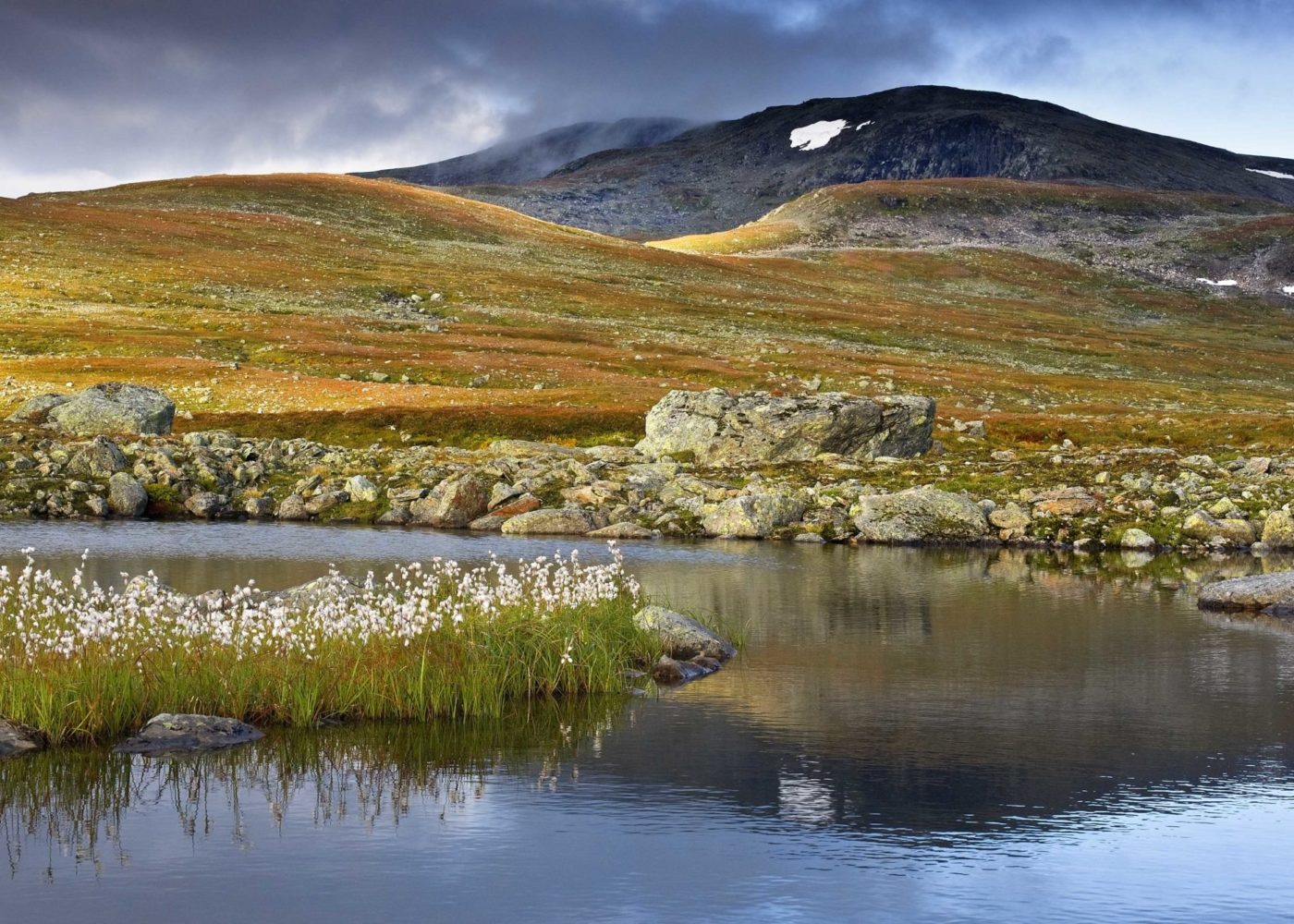
Sheep, goats and reindeer will spend the summer there and taste great. It's not done on that particular mountain at present due to... explanations vary, and generally contain some or all of the words "market price", "herders" and "bears".
I suppose you could say that keeping sheep there is less efficient than transporting grain from somewhere else. But that isn't the sense of "efficient" you had in mind, is it?
I don't know about Norway, but in general you might be underestimating how much that landscape looks like that because grazing animals range on it.
See e.g. this thread about Iceland & my top comment there, but perhaps the amount of ecological destruction doesn't carry over to Norway: https://news.ycombinator.com/item?id=15515292
Norway is different from Iceland, which is a key reason why Iceland suffered. Settlers brought along practices that had worked for centuries in Norway, but Iceland's soil and geology are very different from Norway, and its native flora and fauna differ too.
There are no trees there because that's above the timber line. The photo on https://en.wikipedia.org/wiki/Tree_line is realistic, the trees do cease suddenly, the horizontal line is clearly visible in the landscape. That photo was taken 100-200m above above the timber line, if my memory of the landscape isn't too bad.
The larger point is that no, that landscape wouldn't be usable for wheat or for hardier crops like rye or potatoes. Some of the world is usable for wheat, some is too barren. One way to get human food from barren landscape is to let animals graze.
We mostly live in cities (built on and) surrounded by flat, fertile farmland, so it's easy to forget that barren areas such as mountains and deserts even exist. But they do exist, quite a lot by area, and can provide animal food without displacing wheat etc.
(Writing this makes me wonder about a farm where I've stayed a few times. Flat, lush landscape, near a river, but the farmer told me that the soil was completely unusable for growing food crops. Only grazing suited the land. I wonder what invisible factors may make land unsuited for food crops.)
Yeah Iceland's definitely a big outlier in this regard, but searching around a bit it seems this pattern holds to some degree in the sort of landscape you referenced, see [1] and [2] (just a couple of relevant papers I found).
I.e. some Norwegian researchers fenced off areas of heaths (the sort of landscape you linked to) and within just a few years those areas were noticeably different.
That's the general effect I'm pointing out, you can't just look at a current landscape that has herbivores on it and conclude it can't be used for other purposes, even something as basic as the tree line can be regulated by those herbivores.
Fair enough, there are other considerations besides just water that make land less practical for growing food crops. It still takes more land--square kilometers--to produce X calories of livestock than X calories of plants. It's just that sometimes there are more important factors than square kilometers. Water, soil quality, markets, terrain inclination.
A lot of land can’t be used for farming crops. But you can shove animals on much wider variety of land scapes. Meaning you don’t need to deforest on the same scale. Coupled with not needing to do crop rotation. Etc etc. Results in less land required.


The actual farm footprint may be smaller, but the feed for those animals was still grown somewhere.
(Of course there are resources besides land. In desert environments, livestock still takes more land, but it takes several orders of magnitude less water, since ruminants can digest dry scrub while humans need well-watered grains. But in places that get plenty of rain, livestock is always less efficient.)