This market is a bust, and there's no value-driven economic model to justify cryptos collectively being worth $50B-$100B.
With any startup, there is an expected future value of the company discounted back to the present. It then just becomes a risk-weighted probability question of whether that startup will achieve that expected future value in the expected timeframe.
Conversely, the valuations of the crypto market are driven mostly by momentum and prayers. It's ultimately a case study of what happens when you mix unsophisticated investors, no regulation, frictionless market entry, memes as an investment philosophy ("HODL") and the psychological highs of winning a lot of money. It's gambling, not investing.
In terms of Coinbase - sure, they're selling pickaxes during a gold rush, but gold rushes end and the pickaxe salesmen go out of business too.
Indeed Warren Buffet made a similar point: if you buy a farm, you're buying the land, the potential to grow crops that people actually consume, etc. whereas cryptocurrency doesn't really have a purpose except as a store of value. It's not a productive asset; it doesn't produce anything. It is a bit like buying gold.
It’s nothing like buying gold. Gold is widely considered to be beautiful, and was considered a store of very high value in many cultures that were completely isolated from each other, and human desire for it has remained consistent for literally thousands of years.
Golds value comes entirely from the fact that we as a society give it value.
The beauty line doesnt work, because then platinum shouldnt have any serious value despite its rarity (it just looks like silver basically)
The industrial value is laughable, but read comments below/above to debate that more at length.
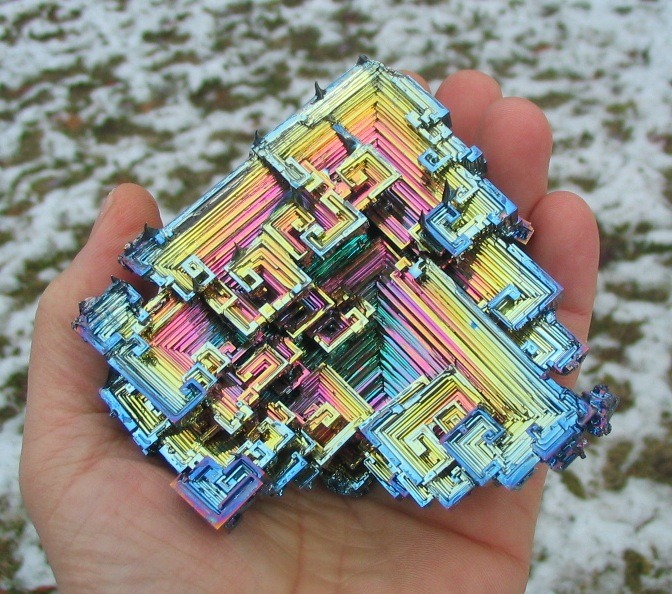
The scarcity line doesn't work, because you have elements like bismuth which are also (Arguably) more beautiful than gold https://66.media.tumblr.com/61ce390242a79a767772d4b2027eb902... but command prices far less despite being .025 vs .0031 on the PPM abundance on earth.
Or even look at ruthenium which has a similar look to platinum and is even rarer than gold. Did I mention it also goes for about 400 an ounce? Quite a savings over gold.
The only thing that makes sense is that we as a collective have decided gold has value of X.
Platinum is valuable because it's an unbelievably good reaction catalyst and is unbelievably rare. Look at Palladium (also used in catalytic applications, and still quite rare) price charts for confirmation.
Bismuth's attractiveness is subjective, but what is not subjective is that it's found in ore in mineral form, not in pure form like gold. It's also brittle, and not easily worked to jewelry by primitive methods like gold.
Anyway, agree that gold is largely assigned it's value based on social reasons. Also would say that, in spite of its many faults, it's a much, much better investment than cryptocurrencies.
> it's a much, much better investment than cryptocurrencies
I'm not going to argue that, on the basis that crypto is super volatile and has potential to outperfrom etc etc.
Gold is a far safer store of value, a much better hedge against market turmoil, and generally easier to "own" at low risk of having it nabbed.
> "Golds value comes entirely from the fact that we as a society give it value."
thats true for anything. that includes currencies, what you get paid, the value of a hockey card, the value of a car, the value of a banana, etc. sure, if society doesn't want to pay you anything for 'it', you can do with it what you want, like eat the banana (before it becomes worthless to anyone).
I am not a gold bug, i personally dont think its a great investment. its not a hedge against a declining market, and its difficult to own in large quantities. however; statements like 'its only valued because people give it value' are not very informative. everything is valued that way. everything.
also, the industrial value of gold is not laughable. its negligible because we have plenty of gold to meet industrial needs. but its not laughable, its in your smart phone, its in your desktop / laptop, etc.
Currencies have value because entities with monopolies on force (countries) give them special legal status to be used conveniently as means of exchange. This is one of the hurdles for Bitcoin, and was a big source of debate in 2016-2018. Every time you spend Bitcoin you have to keep track of the avg. acquisition cost and resulting realized capital gains for every transaction to be able to declare the appropriate gains or losses on your taxes at year-end. A heavy burden for a "currency".
> statements like 'its only valued because people give it value' are not very informative
If you go to first principles, sure, everything is an illusion. But gold, crypto, and other "stores of value" derive their value in fundamentally different ways than everything else. Our existing models and body of knowledge do not apply to them. This is worth investigating. All other things are consumed in some way or another, and the rate at which they are consumed, relative to their supply, determines their price. The consumption of gold relative to its supply is much too low to justify its price using the same models.
Perhaps a better way to frame the argument is that Gold is useful only because society has agreed that it is a store of value.
Things like cars and bananas are useful outside of being a medium of exchange. You can use a car to get around, and you can eat a banana if you are hungry.
Dollar bills and Gold are useful as long as society agree that you can exchange them for cars and bananas. When society stops agreeing that currency is worth anything (i.e. hyperinflation), money becomes worthless and people throw it away or burn it.
Typically, printing excess currency is what causes it to lose value. Gold avoids that because you cannot just "print" it - you have to physically mine it from the earth by exerting effort.
Those qualities are part of it, but not the whole story, gold is also:
- divisible (including literally soft to divide)
- fungible
- identifiable
- verifiable
- scarcity tested (people have been looking for, and trying to create, gold for so long without success that supply estimates can be trusted)
And the big one: branding.
Money is only useful when everyone uses it. It has one of the most powerful network effect of any system. The fact that it was successfully used as money for thousands of years, and everyone knows it, making it the default non-fiat money in terms of mind-share - has enormous value. Are you really going to try to convince everyone to exchange bismuth instead when fiat collapses?
Gold has embedded demand via governments, a global jewelry industry, and yes industrial demand. Bitcoin demand is speculators (mostly) and a handful of people who use it as a transactional value store. Comparing the two is a waste of time - they are nothing alike - but ignoring that the supply and demand picture for gold is way more stable -- global demand for gold does not halve over a few months, which is likely what drove the price shock with Bitcoins.
Gold's value comes from two main things - it's nice for jewellery and it's expensive to mine. The price has for many centuries approximated (within 3x or so) the mining cost and it doesn't drop to zero because it made nice jewellery from Varnian jewellery 6000 years ago (http://www.ancientfacts.net/7-oldest-pieces-jewelry-world/) to modern wedding rings and that's not changing in a hurry. Both mining costs and market price are about $1200/oz at the moment. Financial uses are a secondary effect that has kind of come and gone.
Supply and demand determine the value of everything and they are both additive. Each piece of supply tips the price scale lower, each piece of demand tips it higher. You have taken several key pieces off the scale, argued (unconvincingly) that each one individually cannot explain the scale's reading, and then (even more unconvincingly) claimed that the scale's reading is therefore completely arbitrary.
It isn't. You just don't seem to understand how it works.
the combination of malleability and resistance to corrosion and acid makes gold a very useful material beyond its value as a currency. there are things you can do with gold that you just can't do with other metals, especially in the field of art and jewelry.
Gold's value does not come from its beauty. It comes from its verifiability. If someone presents you a sample of gold you can very quickly verify its authenticity and approximate purity with very little technology.
While funny, it's actually not easy to verify the quality of manure.
> Animal manures are a valuable source of nutrients for crop growth. But, since every farm operation is different, each manure will have unique characteristics. Make regular laboratory manure analysis an important step in your manure and nutrient management planning. Understand that the total nutrient content in manure is not available the first year and that some nutrients may be lost depending on management practices.
let's not be so down on cow manure. Sure in small quantities cow manure is an inconvenience you wipe off your shoe. But in very, very large quantities it's an extremely useful argricultural material you can build a business around. (fertilizer)
I mean, I think Bitcoin is really beautiful. I'm not sure it's as multipurpose as gold is (it certainly doesn't seem to have many uses.) But the basic idea really is a beautiful algorithm. I'm just not sure it has serious applications. Which is definitely unlike gold.
Bitcoin is really ugly. The utterly ugly algorithm requires storing of enormous amounts of waste data and requires extremely unefficient computational work of "mining". It's just a showcase of human greediness and stupidity.
I’d say the point is that one can appreciate the beauty of bitcoin design without owning any, whereas appreciation of gold is much more tightly connected to physical interaction with a gold artifact. At least in sane people.
Gold enjoys a lot of fashionable demand. Which is very much why you shouldn't use it to store your money - because not enough is actually propping up that demand. It just has a longer historical inertia - if you want to see a future problem, depending on the mineralogical analysis of near earth asteroids we could be in for a long slow decline if it's abundant up there.
I'm talking about industrial usage - like the contacts on your CPU. Gold offers a unique combination of very high electrical conductivity and near-immunity to corrosion.
Gold has been more stable in real value that pretty much anything else over the last 6000 years. Land being the only comparable asset I can think of. Way more stable than paper or crypto money. You shouldn't store your wealth in it because it's kind of stable while income producing assets make money.
There are comparisons being made that 1 gold coin used to provide 1 Roman toga, a good pair of leather shoes, and a good belt. And the comparison suggests looking at the cost of today's fine suite, with good leather shoes and said belt.
If true, gold's value has not risen, the currency's value it is being measured with has gone down.
The current gold price is a combination of industrial usage value (price higher than coal as it's more rare) and perceived value, but the difference is not that huge compared to other metals, so I would say the goldbugs are not completely wrong.
Coming from the investing world, I won’t say this is entirely true. If an ICO token is a genuine utility token, then it could have true value in the distributed network as far as I understand. If some company takes off where this utility token/security works, it could be a preferable form to a more common IPO/listed equity. I don’t think many companies fall under this domain, but for a few types of circumstances, the ICO model makes a lot of sense.
Can you provide any examples? I literally cannot think of a single company that needed to do an ICO for reasons other than to make quick money. I’m actually far more skeptical orf ICOs and adding blockchains to a company for no reason than bitcoin as a mere currency solution. We don’t need an ICO and a blockchain to track bananas in Laos.
I think the hard part is we haven't seen anything take off in reality yet.
I've thought about one from a conceptual standpoint. In finance, many buy-side firms are collecting the same alternative data. This might be anything from consumer reviews to executive flight traffic data. So, could the buyside band together to create "Bloomberg"?
More buyside firms now have data science teams, and with the explosion of alternative data, you could make the argument that the DIY is too taxing for one firm and the vendor is too slow at incorporating new datasets, and merely is the middleman. I don't think a hedge fund would give away its secret sauce, but much of this data eventually becomes table stakes.
I've thought about whether a token could be created to provide an incentive for firms to build and share datasets. Tokens could be rewarded if a large number of other firms use/read from a particular dataset, or another firm could fork a dataset to clean dirty data and potentially tokens would flow to multiple firms in this instance. More firms using the network should lead to more data and a more valuable network/token.
Maybe the closest real-world example I've heard so far is the Catalonian government using IPFS during an election, and how Filecoin could be used on top of IPFS to pay people to store data:
Human civilization is at least tens of thousands of years old(just considering what modern man believes) and always valued gold more than anything for both store and exchange of value. I don't see why modern civilization(which were ahead of us in all domains) would feel any different from their ancestors for gold.
Gold as metal has something more than what makes it scarce and valuable, something we have yet to discover. There's a good reason why all central banks of all economies(US,Chine,Russia) are holding on to gold as much as they can and buy/steal more of it as the opportunity arises.
Even if you live out in the middle of nowhere, you have to pay property taxes. If you barter, you have to pay taxes on that stuff too, so you need to make the fiat bucks somehow. That's why fiat being required for taxes is the big one that makes it the defacto standard. After all, you have to have it, or its electronic equivalent or people with guns will come and get you, imprison you and take all your stuff away.
Not that paying taxes is bad. It helps keep inflation down vs the government just borrowing all the fiat it needs from the fed. However, if you try and run your whole life in gold or bitcoin or whatever you just can't do it legally.
Beyond that the government only accepts fiat for tax payments, tax payments are denominated in it. It’s a small distinction but an important one, as swings in the value of the bartering asset you’ve been trading with as we see today can put you massively behind on your tax payments.
In my opinion it’s likely that they are holding the $130B of cash equivalents because they’re expecting a downturn in the economy and want to buy up assets on the cheap. It’s not that they are investing in the cash, they sold some assets at what they perceive to be at the top of the market and are holding for the next downturn so they can get back in on some discounted equities. This is large-scale buy low sell high. It’s not a productive asset but a short term store of buying power.
I think it can be rational for an investor to forgo productive assets, even if they have no opinions about market timing. They might look at a company, estimate its lifespan, estimate its total inflation-adjusted earnings over that period, and find that it's less than the current market cap. In that case it's just not a good investment opportunity, irrespective of market timing.
Historically there has always been a shortage of capital, and plenty of productive enterprises competing for that capital, so investors have received a discount on expected future earnings. But I think the case can be made that in the current economy, there is no such discount. That appears to be Buffet's stance, judging from his public comments. He says that he doesn't practice market timing, but simply can't find many worthwhile investments.
Not all cryptocurrency has no purpose. To me the “store of value” has always been a copout due to Proof of Work based ledgers painting themselves into a corner and being unable to scale to support enough transactions to support real payments. So all people can so with eg bitcoin and ethereum tokens is speculate.
That is changing with the next breed of cryptocurrencies like Stellar and EOS. Take for example https://intercoin.org (disclaimer: working on it). It is explicitly designed to solve real problems, and the applications are listed in the video.
I consider Bitcoin and Ethereum to be the myspace and friendster of the industry.
This is why people dislike the crypto space. Someone is always shilling their project. I'm not saying intercoin is a scam but it certainly looks like one and it's ridiculous for you to be calling Bitcoin and Ethereum "the myspace and friendster of the industry" when your project has literally no advantages over it, lots of disadvantasges, and no public code. When projects like this get burnt out of the space from the bear market, we can finally start realizing the potential of decentralization.
Nothing in your message is backed up by any arguments. I would love to know for example:
Why Intercoin looks like a scam
Why it’s ridiculous to be calling Bitcoin and Ethereum the myspace and friendster of the industry when they are literally the first movers and have been around for 10 years but painted themselves into a corner and are unable to scale - no one uses bitcoin for real world transactions and projects building a token on ethereum who needs it to be actually used regularly says they’ll get off ethereum right in their whitepaper (Kik Messenger for instance).
How can you say Intercoin (or EOS or SAFE network or Stellar) has no advantages over Bitcoin and Ethereum, what planet are you on?
We have half a million lines of public code written over 7 years. We have been trying to fix decentralization for longer than you knew about crypto. And MAidSAFE has been doing this for 12 years!
Why would “projects like this” be “burnt out of the space” in the bear market, when I just said they are the future of the space, which has stagnated?
The promise was utility tokens and ICOs, where the tokens would be presold and the network would be owned by the participants instead of extracting rents. Tht was the dream. That was chilled by regulators, in favor of security tokens.
This reaction is what’s ridiculous. Imagine me saying this about MySQL for instance, or Wordpress. It looks like a scam guys. It has no advantages over current first-gen database systems or CMS, and there can never be anything better
Do you really, honestly think that a system burning more electricity than most countries to do 7 transactions per second, where each full node needs an ever growing amount of memory to even join the network, is the best BFT database and distributed ledger that can ever exist?
Look at other projects like Holochain and Maidsafe. Look at the evolving EOS ecosystem. “People” who dislike cryptocurrency hardly know what’s going on it. “People” also disliked the Internet, the Web, social networking, and thought it was a fad. At the very least, answer my questions point by point and bring some substance. Other people are working for years on free open source software, instead of cushy jobs at some cushy VC funded startup, which is likely to fail, and you are calling THEM scammers because...?
You do realize that these projects produce open source software AND are looking to build a decentralized ecosystem where you no longer have to extract rents and have middlemen like Facebook which can be hacked, influence elections etc. And meanwhile you say once these projects are burned out and we go back to ethereum THEN finally we can get back to the business of decentralization? Ha ha ha.
Agreed. I do some EOS smart contract work on the side (personal tinker projects) and its incredibly impressive.
If you haven't played around with EOS and are interested in blockchain computing you should check it out. Being able to write C++ code and deploy it on chain is pretty dope.
Yeah, but what can you actually do with it? The killer use case for smart contracts so far has been Ponzi schemes and gambling games. I have yet to see a smart contract actually do anything useful/legal.
BTC is still around $3500, not bad for something that was worth a few hundred three years ago. I'm not willing to call it dead just yet. There are plenty of assets that make little sense to value, and yet they are. The bias here is to assume that cryptocurrency is useless or valueless because the technology isn't all it's hyped up to be, and that is true, but value is not a rational game. Let's wait and see how it develops.
I'm not arguing that BTC hasn't returned value to earlier investors.
I'm arguing that cryptocurrencies don't have the same economic model as most startups - which is essentially the expected future value generated by their operations discounted to the presented.
There are startups within that definition that have a low probability of achieving such - but it's the same fundamental economic model that applies to Apple that applies to a seed-stage biotechnology startup.
This doesn't extend to cryptocurrencies - given that currencies don't generate operating cash flows.
Sure, there's no rational way to predict what bitcoin "should" be worth like with a startup, or any other company. Exactly because it's less a technology and more a social construct, as you say it's based on momentum and prayers, it's worth what people think it's worth.
We may not be disagreeing, I took "this market is a bust" and the picaxe seller analogy to mean that you foresaw cryptocurrencies dying out completely, but you may have just been referring to the crash that's already happened.
Wait, isn't that a false equivalence? Plenty of compelling rational arguments have been made for a $0 Bitcoin: its value is based on mania, it competes unfavorably with other cryptocurrencies, and it sees minimal (and decreasing!) real-world use as a medium of exchange.
Bitcoin will probably never go back to zero. The money laundering and selling of drugs / other criminal activities will continue using it therefor it will keep some small value. It has a long way to drop from $3500 though. Altcoins though will probably go to zero as they are completely useless compared to BTC at least being useful for criminals.
It's just Bitcoin addresses, not linked to individuals, doesn't matter it's in the ledger. These people don't go through exchanges with KYC I'd assume. They might do something like localbitcoins or shady exchanges in countries like China/Russia.
What am I falsely equating? I don't think that the store of value argument is absurd, even with real world assets like gold their value is really just socially constructed. I don't see why it couldn't in principle be the same for bitcoin, it just needs to be the biggest cryptocurrency and concrete the idea of it's own value in people's minds for a long enough time, until they take it for granted. Whether that actually will happen I don't think anyone can say. I think it's a mistake to assume that the value here has to do with the technology, e.g. the "best" cryptocurrency must win. It's likely just long-term momentum.
The arguments suggesting Bitcoin has an intrinsic value of $0 have rational, evidence-based premises, like the notion that Bitcoin is technologically inferior to some of its competitors and the lack of its use as a medium of exchange. You can't generally say that about the arguments in favor of Bitcoin, though I'm happy to hear counterexamples.
The "store of value" argument doesn't mean anything. Beanie Babies, tulip bulbs, and Hummel Figurines are also "stores of value".
Artworks, antiques, gemstones. None of these are of any practical value, yet they hold value. You’re over systematising and not getting it. Value isn’t inherently rational.
Because otherwise your claim for Bitcoin's ability to store value is circular. Bitcoin has value because it's supposedly a viable tool for commerce. But it's not currently useful as a medium of exchange, and it competes with systems that are far better than it.
Yes - we probably don't disagree. I believe that there's probably some technological value in digital currencies.
In terms of the "market being a bust", the statement was a criticism of the current valuation of the cryptocurrency market - particularly, that it is based on a cauldron of unholy factors that I mentioned in the first post.
Do you know of any "work tokens" which are not minted for free and sold to speculators before entering the closed loop economy of their giftcard network?
Before this huge speculative boom, shady characters could use cryptocurrencies to buy drugs and launder money.
Now, with KYC/AML implemented by exchanges worldwide, plus the outright banning of the coins in some countries, those activities are much more difficult.
If you want simply transfer money internationally, services like TransferWise do it better than any coins.
Yeah, it doesn’t really have utility. It’s a thing other people will trade things for based on a kind of collective insanity. It just happens to be the same kind of collective insanity that we apply to lots of things, only we dress this thing up in tech-speak while we dress others up in aesthetics.
The question is how much, if any, of that price is derive from actual market activity and not scams like front running, tape painting, spoofing and just plain tether. If people actually tried to move any serious amount of it out it might just fall down on itself, that number may not be real.
> there's no value-driven economic model to justify cryptos collectively being worth $50B-$100B.
Of course there is. You are just starting from your ideology (that there must be no value to them) and work backwards to your dismissal and so you have closed your mind to the possibilities.
Here's 1.8 trillion of possible value, just to help put things in perspective
That’s all fine and good, but that doesn’t mean that most of those cryptocurrencies are suited to addressing that market. Pretty much only Zcash and Monero are. Those represent only a tiny fraction of the market. The big problem for crypto though is that if it is only used for narcotics, and there’s no plausible use case otherwise, it’ll all get outlawed. For it to support that business it needs to have an equally large legitimate use case and it definitely does not. Otherwise the early adopters will have just about as easy a time cashing out of this is as they would the underlying narcotics.
> Compares equities to digital assets that function like commodities. Then ironically makes a gold commodity analogy
The startups that issue the digital commodities are doing ok and can still raise.
The digital assets they created would be valued more by their utility and scarcity, which would have ebbs and flows just like a commodity. It is fine that they dont have utility or scarcity, if the infrastructure and ux around them improves than they will and you can pick them up from the lows. There is a reason that commodity trading never made it into the retail investor portfolio, as there is no reason to have passive investment in them
As long as you, and the retail investor, continues expressing their unfamiliarity with this market through equity investment analogies, the information asymmetry will maintain massive and advantageous to those that do have a valuation model.
This changes with proof of stake. If you own enough tokens, you can 'stake' them and run a node that generates blocks. In return, you get transaction fees. This makes the token effectively a share in the network.
See that's the thing. You shouldn't buy any of these for investing - only for use and only when you need to. These are all mostly 'utility tokens' being added to Coinbase. One of the biggest areas that these might see usage in the future is decentralized finance and decentralized gaming. Probably the most interesting project now is DAI, and no, people definitely do not buy DAI because it's going to go up! There are some other great projects listed there, and I urge you to take a closer look at them before you dismiss them.
Yes! You can actually do this on the blockchain right now: buy DAI on a decentralized exchange (or mint your own DAI by opening a Collateralized Dept Position), then lend it out for interest. (Last time I've checked, the paying interest rates were very attractive). The tech is still very experimental, but has been functioning well for almost a year, despite this year's deep crypto market crash.
I also think those who think crypto is only useful for speculation or crime are very much stuck with the 2013 opinion of it.
Aha! That's an interesting question. "Pennies in front of the steamroller" is an oversimplification. Only DAI seems to be paying a high rate right now, other tokens not so much. It may be just because of supply and demand, there is quite a lot of demand for borrowing DAI. Why there might be demand for borrowing DAI may be too complex to explain to the hackernews crowd, so I'll leave it at that...
First of all, if it’s too complex to explain to all of us, it’s probably not a good idea. Second of all the steam roller referenced is the entire implosion of the crypto space. You’re getting fractions of a penny in interest which you could easily achieve in the real market with much much lower risk.
It's not that it's too complex because it's hard to understand, it's just that the explanation is long, and it will get downvoted anyway, so no use of explaining anything further. Save my fingers from typing. HN is a waste of time.
The value would need to become a lot more stable. I doubt people are getting a better result with crypto than a standard forex broker right now. Only use case I can see would be when your cross border transfer is going to be on the wrong side of the law at either end.
Pretty sure anichhangani is referring to consumer cross-border payments, which right now are not cheap or fast. Wire transfer fees are a joke and banks often take stupidly high commissions on currency conversion for non-institutional customers. There are some smaller services that have popped up in the market for this recently, but one of the original cryptocurrency use cases was basically "nearly free value transfers from anyone to anyone anywhere". The exchange fees have mostly destroyed this use case, but there's no reason spot conversions to/from a cryptocoin with a wallet transfer within a few seconds couldn't be possible.
The existing mainstream banking system can easily handle instant payments to anywhere already, they're called wire transfers. Within certain regions like the EU, it can be even faster.
The only reason international payments can be somewhat expensive is because of all the regulation involved into balancing a global currency system and making sure you're not funding the wrong people.
Not sure where you are, but here in the US wire transfers are slow and also expensive. Last time I had to do one internationally, it took several hours to clear and cost me something like $30.
NACHA (the U.S. body that governs ACH transactions) just started supporting international ACH transactions over the summer I believe. An ACH transaction typically costs the consumer between $0-5 (depending on how quickly they want it sent) compared to a wire transfer that could be $50 or more.
Yes, because of the regulations. If you have any history of transfers then you're usually approved within minutes vs occasional usage. You can also improve the speed by using an abstraction service like Paypal which offloads some work while charging more for the risk.
Besides speed, another interesting property of cryptocurrency based transfers is that they can be programmable. For example simple escrow or multi-sign off transfers or time-delays, all easy to do without lawyers or additional fees.
That's a trivial detail. Whatever you use for trust (the escrow or signature service) can already handle the scheduling. No need to bake that into the money itself.
The reason we have lawyers is because the law is not just black and white. As many examples have shown, pure robotic management is not conducive to how people actually do business and the messy nature of human behavior.
This problem has already been solved without cryptocurrencies, check out TransferWise or myriad other solutions. The reality is cross-border payments with cryptocurrencies are always going to be more expensive because you have to convert fiat to and from your crypto medium on both sides with a 1 to 3% fee where transfer wise charges as low as 0.85% total. Sometimes less. Not to mention volatility risk over the course of the transfer oh my.
The cryptocurrency "hope ponzi" is predicated on a relatively unfalsifiable hypothesis: given enough time and effort, geeks using math can create software that will completely nuke our existing economic system.
The result of this unfalsifiability is the rapid "boom-bust" bubble cycles we see in crypto prices:
- 'informed' speculators buy early on the thesis that 'the old problems have been fixed from the last bubble.'
- typical bubble dynamics play out like 'greater fool' and 'your plumber is buying' rise up to the peak
- "problems" are brought to the forefront in the speculators' minds in response to events (in this last cycle, it was 'the network can't scale' in response to DoS attacks and 'the SEC is bringing the hammer' in response to their memo(s) for example)
- alternative, more foundational valuation measures fail to emerge through the cycle other than the primary hope and speculation in the promise of cryptocurrency, and so the bubble pops once a few whales start harvesting gains
- people lick their wounds, the press stops talking about crypto for a while, and people stop checking the tickers. developers are further enticed to keep working in the space because they can optimistically whiteboard out theoretical solutions to a good chunk of the "problems" (the ones that are due to technology or design limitations.) this is happening right now within the ethereum community, all hope is being pinned on the next set of features.
- in 1-2 years when plausible 'solutions' to the primary problems identified in the last cycle emerge the cycle repeats. note this doesn't mean they actually need to solve the problems, just be plausible enough to induce FOMO in early speculators that 'crypto's time has come.' if you recall this cycle there were memes that took hold around ethereum smart contracts being the missing piece, and that ICOs were going to incentivize innovation properly.
the only way in my mind that this cycle breaks is either a) a more grounded valuation metric comes forward based upon demonstrated value for crypto which rapidly causes some kind of pseudo-market efficiency (but still lots of vol) or b) interest in the ecosystem wanes so much (due to other emerging tech stealing talent or enough people being burned) that the brain drain causes the tech to stagnate and the sentiment that "crypto is dead" takes hold alongside this inertia or c) some fundamental flaw eradicates so much wealth so quickly that it affects most people in the economy. These seem hard to imagine right now, so my guess is we have at least a few more cycles.
Two signals that the ecosystem is perma-dead (if you ask me) is if we see:
- No active development going on due to "emotional capitulation" by most all tech talent (def not the case now)
- We see a crash which directly affected a large % of 401ks (not possible bc bitcoin et al are not fully securitized yet)
Market price action in and of itself doesn't say very much (to me) about if we will see another cycle.
Tech talents' emotional capitulation vs the fact that at this point many are financially independent and free to do whatever they want is also an interesting dynamic.
Were financially independent. The crypto millionaires I know who rode the trend all the way up to the top rode it right back down to where they started. It makes sense, the kind of people who would hold onto crypto unconditionally until they became multimillionaires are exactly the same kind who would ride right back down to zero.
Murdered with words. I have to admit to more than a little schadenfreude. Future generations would likely want to sent back time cops to arrest crypto miners for their egregious waste of energy.
Most POW mining is powered by renewables, and the fraction that isn't is continuously motivated to power-optimize by innovating in either computing or power efficiency.
Any miners paying less or the same as the lowest have no motivation at all. And dirty energy (e.g. unscrubbed coal) or energy from backroom dealings (tons of mining arrangements in eastern Europe and China) will always outcompete any legitimate competitors using renewable.
That's like saying "Apple is already the biggest company in the world, they have no motivation at all to keep making new, good products." Obviously they are under continuous threat of not being the marginal best.
I believe it is important to look into other consensus algorithms that are not as energy heavy, but I don't think mining should be considered a crime. Also, it is important to remember that the detrimental cost of energy waste is dictated by how we are getting that energy. If the source of energy is clean, efficient and abundant then there is less need to ration our energy use.
Part of what attracted me to the concept of crypto-currency was the ability to conduct financial transactions in a medium that was not being inflated by central authorities. If it were accepted by more providers of goods and services, I wonder how the energy used to "mine bitcoin" would compare to the energy used to "run central bank offices?"
> Part of what attracted me to the concept of crypto-currency was the ability to conduct financial transactions in a medium that was not being inflated by central authorities.
Seriously? Are you sure they are worst "wasters" of energy on the planet right now? What about cars, and eating meat, and Christmas lights, and so on? Have you checked your own energy consumption today?
It seems to work well enough for at least some use cases, no matter how low the number of transactions. Further developments like Lightning Network are being worked on to enable other use cases.
I don't like if they burn coal for it, but there are also other energy sources, sometimes there is even spare energy that needs to be used somehow.
For those of us in the industry, we recognize that this is all one grand experiment. In my mind, it is worth all of the hype b/c digital currencies pose the following two big benefits:
- Digital currency is a new asset class and an improved form of money. Money as a concept has been around since the dawn of recorded history and it has gone through a number of iterations since. We have only been using nation-backed currencies for between 100-200 years depending on where you set the departure from the gold standard. For most of human history, we have had "hard money", meaning that no one had the power to inflate our money and lower its value(through gold). Nations have that ability today, and it has had far reaching implications. Digital currency has the potential to reduce or eliminate government control of our money. If you think this is a libertarian vision, you would be wrong. Just look at the internet and how it has quickly changed the publishing industry. Digital currencies are also programmable, meaning they have features that normal money simply does not have. Shared custody of funds and time locked funds are just two great examples.
- Digital currency paves the way for superior payment networks. The ability to send digital currency is cheaper, faster, and more global than any payment network ever invented. Our traditional financial system is steeped with trust-based relationships, manual checks, competing parties, and fraud. This results in inefficiencies from top to bottom. This all results in bank wires taking between 4-14 days, whereas a digital currency transaction takes an hour to settle on average. In the future, digital currency will also be capable of sending smaller value transactions than ever before.
If you think that aspects of this industry are ridiculous and mere gambling, you would be correct. As a person in the industry, I tend to ignore much of the industry. That being said, there are some incredibly novel ideas that are motivating the best of us to get this system working. If we succeed, we will have a much more open, fast, less expensive, and global financial system to use.
I suggest you learn more about the financial space. In no world do bank wires take 4 to 14 days. Trust is an efficiency. Inflation is not bad because you’re not supposed to be using Cash as an investment you’re supposed to be investing it, as long as you’re not doing that under a mattress, inflation is a relevant to you other than as a forcing function toward investment. Nobody wants to be their own bank, it sucks that’s why we have banks.
I’m not saying banking is evil by any means, but I do think the whole industry could use some competition. The industry moves super slow, and I think digital currency would make things far more competitive.
I think digital currency’s improvements to money, that I mentioned, are the point.
I don't see it exactly like this. I see where you're coming from, but some of us who buy cryptocurrency believe in the technology and back only projects that we believe will have a future. It is still speculative on an investment level, but I also use this technology and hope to build on these protocols in the future. The space has a lot of growing up to do and I hate the "wen lambo" mentality because that is not what this is about for me and I believe it deviates attention away from technology which is what is actually important here. Not every blockchain project will succeed, many will fail
Your analogy is flawed though, Coinbase wouldn't be selling pickaxes they are simply providing a means of digital asset exchange as well as selling the digital assets directly. Mining hardware would be the pickaxe.
Like it or not, it's a phrase that dates back to Mark Twain that has far more baggage than some strict analogy made up on the spot. For instance Chris Dixon here[1] suggests that Heroku and Akamai sell pickaxes, not dynamite as a service or scalable ore transport systems.
All I'm doing is defending the GP's use of the phrase, which was absolutely valid. Perhaps you'd have used a different analogy, but it doesn't invalidate his. No quantity of curt denials you care to throw my direction will change this.
My lord, it’s an expression, it’s not literal. Pickaxes in this metaphor are any and all tools in between an individual and their target. You would be totally right to say banks are selling pickaxes in the current financial system.
The idea behind the phrase is that when a ton of speculation money is flooding in to a market, you should make money by proving services to the speculators, not by speculating yourself.
Creating mining hardware is actually more speculative than an exchange, because you're picking winners and losers based on what your hardware can accelerate.
Selling pickaxes to miners has been used to describe platforms like CDNs or game engines like Unity. The fact that there is something called a miner in this context is a red herring.
I guess they could be the pickaxe salesman depending on how you frame it, but that's just who they are. I guess I'm bringing in actual PoW mining which the analogy has nothing to do with.
I don't think they are speculating though, they are simply doing what they do and have always done. Provide a means of exchange from national currency to digital assets. It is up to the people who build around these protocols to create more ways of utilizing these digital assets through services.
It's hard to say what's going on in this market but I don't think it's a bust. A lot of money went in really fast and then huge sell offs from Mt Gox recovered bitcoins. Bitcoin is still somewhat interconnected in price with most altcoins because of pairings, and any major selloffs seem to drag the whole market down. I think it will mature in time and more people will actually utilize cryptocurrency and not just buy it for speculative reasons. Value will be established over the next few years as practical use grows.
Well it is still very young and business innovation moves slow and cautious. Also regulators have not fully decided on a few issues that are very important regarding digital assets. I believe there is a lot going on behind the scenes of a lot of major companies right now though. Mostly in terms of hiring and r&d. Even Facebook is hiring blockchain engineers. I think this will all develop in time.
“Coinbase Abandons Cautious Approach” seems a bit hyperbolic as a title. In fact, it sounds like they're still being cautious. They aren't saying they will list a ton of new “currencies”, they just listed a number they might want to explore, and they are going to take their time deciding which are reasonable:
> Coinbase recently revamped its policy on new token listings. [… Coinbase] now goes public with its intention to “explore” the potential to list new assets in order to lower the impact of a listing. It also doesn’t guarantee which, if any, will make it through and be listed.
> “Adding new assets requires significant exploratory work from both a technical and compliance standpoint, and we cannot guarantee that all the assets we are evaluating will ultimately be listed for trading,” the company said.
It's the end game for sure. The whole ICO utility token thing we've seen over the past couple years has just been an intermediary step while companies navigate the regulations.
The idea is that stock certificates, and the Depository Trust Company will be replaced by block chain tokens and dividends would be paid directly to the holder on the block chain. When he says it makes sense for everyone with a cap table to have their own token that is what he is talking about he isn't suggesting that every company in the world should jump on the ICO bandwagon.
There are a bunch of companies pursuing this right now Coinbase is one, that's why they bought a broker dealer. Overstock / tZero is another.
If you ever want a fun simple math problem. Calculate how much hashing power you need to accumulate in order to 51% attack some of the lesser quality cryptocurrencies. It is very feasible for the right actor.
“51% attack” is meaningless if you can’t find a way to profit on it. It costs money to run an orphan chain that long. You can’t simply double-spend because you are the biggest miner so long as everyone is running software that prevents it. To profit you must find a way to earn money with transactions on a given chain that are then wiped out when you release the longer chain.
The typical way to profit from this is to deposit to a centralized exchange, trade it for something else, and withdraw before the exchange recognizes what’s happening. However there are simple calculations you can make with the cost of 51% hashing and then the exchange can bump up the minimum confirmations required for deposits and limit the amount you can deposit for weaker currencies.
In general the 51% problem is no longer easy to profit from except with low quality exchanges.
I think the attack looks like, two transactions at the same time, one sending to exchange or merchant, one sending elsewhere (back to owner). Keep orphan chain open long enough for merchant to send goods or exchange to payout. Then release orphan chain and have it "snap back" to a world in which you received something but didn't have to pay for it.
It's quite hard to find a merchant that accepts a cryptocurrency so unpopular, that a 51% attack on it is relatively cheap. And any exchange that really cares about the security of its funds has very long confirmation times for such cryptoassets and/or monitors those chains for any suspicious activity so that the withdrawals can be frozen if anything happens.
Not saying it's impossible to do a successful 51% attack, just that it's a lot less trivial than it might seem after checking out a site like https://www.crypto51.app/
this site only indicates how much it will cost per hour to sustain the attack. it is unknown how long it could really take for attack to be successful, also as others pointed out - there's no incentive
But yes, most of these garbage tokens can be attacked. But it is quite evident to me that eventually people will understand that it is just Bitcoin that they need to follow to keep up to date with the field of cryptocurrencies. Others claim to bring cool concepts and technology but in actuality they don't work or are a messed up very large software project like Ethereum (and tons of projects don't are simply forks with no further development)
How many of the coins in this list are heavily premined, and the high marketcap/attack-price ratio is only related to the big amount of coins hold by the creators?
Is it possibly to see other indicators like daily volume? (that can also be manipulated ...)
Interesting site. Only thing I would change would be to find the attack cost based on block time. Ethereum has a block time of 15 seconds whereas Bitcoin has a block time of 10 minutes. This changes the amount of damage that can be done in a given amount of time.
Nice! I didn't realize you were on HN, I've sent your site to friends before. I'm curious -- has your traffic increased or decreased lately (due to the bust)? Do you track your traffic or graph it at all?
I track it via Google Analytics -> here's a screenshot of the last few months [0]. Traffic has been pretty steady over time with a few spikes from Hacker News or Twitter mentions. I believe the most recent spike in traffic is related to the 51% attack against Vertcoin [1].
Oops - good catch. Monero moved to a new mining algorithm (cryptonightv8), and crypto51 was using an old hardcoded list of NiceHash supported algorithms. I just updated the site to use the NiceHash API to keep this list up to date [0].
State actors would find it very feasible with Bitcoin, too, if they decided it was in their mutual interest.
ASIC production for Bitcoin mining exists only with the implicit consent of the governments of the handful of countries that contain fabs capable of leading edge nodes.
It would not be difficult for these governments to secure a monopoly on ASIC production, and at trivial cost launch a permanent attack on the network.
It’s much easier than that, all the bitcoin hashpower is in the PRC, all it would take to initiate a 51% attack is for Beijing to send a strongly worded memo to the miners.
No, the government could not force Bitcoin to adopt a new hashing function. It would be nearly impossible for any government to enforce a hardfork like that.
Why do you think doing this in the open would be more beneficial?
So if governments were to seize a monopoly on ASIC production for Bitcoin, the community would cede control of the hashing power to them rather than swapping to something else?
Many coin projects hope for a Coinbase listing as a way to boost exchange rate. Broader markets mean more liquidity, which in turn means more investor interest.
I'd like to offer a counterpoint: that Coinbase listing is likely to kill the tokens that get listed.
Shitcoin speculators are attracted to volatility, not technical merit. The wilder the swings, the more engaged they become. By adding liqudiity to a token, Coinbase dampens volatility. Projects must then compete on technical merit, which means most will fade away as new tokens not listed on Coinbase emerge.
Second, shitcoin speculators trade with the understanding that they can evade taxes by trading on unregulated exchanges. By muscling out competitors, Coinbase will drive middle tier exchanges out of business. Given its strict guidelines around AML/KYC, Coinbase will make it very difficult for speculators to conceal their tax liabilities. This in turn will drive out most speculators who will see little advantage of cryptocurrency over traditional forex or penny stocks.
Bottom line, this move will not increase demand for trading more mature tokens, but dry it up. Speculation will instead take place on thinly traded, unregulated exchanges.
Interesting point of view, although crypto market has proven irrational most of the time. But indeed liquidity tends to bring the price closer to the real value, which is much lower than the current traded value for most of these tokens.
Crypto may have its usage but the coins themselves aren’t worth very much and the market does not value them very much. Why? Only maybe 3% of crypto buyers understand the technology, understand the boom/bust cycles, and essentially understand what exactly it is they are buying. The other 97% are irrational actors. They are common people who hopped onto the craze after the wild media frenzy, heard from their colleagues about a magic coin that exponentially increases in value, poor and lower middle class from other countries who really don’t understand it, and the tech pseudo crypto literate community who repeat the similar phrases: the technology is legit, but some coins are overvalued, alt coins are useless but etherum and btc are useful, crypto is like the dot com bubble and a few coins will survive and turn into the next tech behemoths. I belong to this latter group though my ego might think otherwise.
In my eyes the valuation is due to the volatility from the 97% of irrational actors, many who pump and dump, and the big players who can do sketch actions with little oversight. This is not an investment class I feel confident in purchasing if it’s almost completely irrational. I am at the mercy of others and chaos and long term these factors will likely converge to a significant loss for me. The one hope being that there comes to be significant value unknown to us now but comes in the future.
Maybe previously they could survive off BTC alone, and it benefited them to focus on the healthiest currency, but now BTC isn't doing too hot, so they feel the need to cast a wider net so they can get a head-start on the next craze, should it come?
Crypto is a different ballgame than the stock market, given concentration of trading volumes in relatively few coins.
To the extent that the investment philosophy leans more towards "HODL" as prices decrease, trading volumes will go down, and trading volumes predicate volatility.
> Crypto is a different ballgame than the stock market...[because] as prices decrease, trading volumes will go down
This happens in all markets. Precipitous price drops scare away buyers and trigger loss aversion (and an aversion to marking down positions) in sellers. That leads to the market transitioning to an illiquid regime and non-viability for exchanges.
I don’t think we’re there yet with cryptocurrencies. (Beanie Babies took over a decade to resolve.) But it may be what Coinbase is guarding against with this move.
Bitcoin is doing much better than all those other scams. Coinbase has lost its credibility in the crypto space long ago, not much risk for them to go all in at this point.
I don't necessarily mean "market value" by that; I mean something more like "public perception". Since the public perception of Bitcoin heavily influences whether the average Joe is going to trade on Coinbase or not.
Sure, that makes sense. But I don't see what better indicator you could have than market value about public perception of an asset, especially one as abstract as a cryptocurrency. Does it make sense to pull the two apart and discuss them as separate things?
The recent market crash is partly the exchanges’ fault. Listing every possible coin out there exposes people to unfinished and shady products. Just looking at that list things like Storj and Tezos, or even Eos and Cardano are very questionable choices.
No one seems to take a stance against this garbage. While Coinbase is currently more selective, with this type of move they’d probably join the rest of the pack.
Also I’m not sure why they don’t include Nano in that list, which is one of the few cryptocurrencies that can actually be used as a currency.
Even highly regulated exchanges don't vet for quality like you're suggesting. Exchanges merely set disclosure requirements so investors can make their own informed decision but even that only goes so far. Herbalife is on NYSE and Tesla on NASDAQ, for example.
It's an interesting and complicated question, but it seems like the coinbase business model should be pretty dramatically affected by the massive sell-off. First, as prices go lower, the average value of a transaction is (probably) declining, so the money they make on fees is (probably) going down as well. Second, as the market looks worse and worse, the number of people casually entering or trading is likely declining too. The have a lot of correlated risk with the decline.
The impact of the variables you mention can't be assessed without understanding the internals of their business. For example, if they have a lot of fixed or hard-to-change operating costs (like headcount) that have been taken on that now assume a certain amount of transaction volume, you may be right. But if they have just had their average revenue per employee spike over the last 18 months (after all, ETH is trading where it was in May last year) then what we just went through was more of a windfall-laden anomaly for their business to accrue a rainy day fund not necessarily something they were dependent upon.
In any case, given the volatility of crypto and the survivorship of Coinbase vs all other exchanges, it'd be surprising to me if they didn't manage their business in a way that assumed a 10X cut in price could happen at any time.
Haha no not in general, but at this point Coinbase has survived some pretty severe market swings, so if you ask me with no additional info (of which I have basically none on Coinbase) I'd assume they at least have some institutional awareness that a 90% drop in all the coins they offer is not perceived to be an "INF sigma" event. (Which it probably was perceived as for a vast number of the know-nothing ICO schemes)
Don’t they live off of transaction fees? My understanding is Coinbase makes sense as long as people are using crypto regardless of absolute numbers involved in individual transactions.
Banks are very valuable despite their tokens being worth only $1
That’s what everyone said about Mt. Gox too: “they can’t be insolvent, they make so much money in txn fees!” That seemed like an airtight argument until it suddenly wasn’t.
they're doing so so that their same investors who have investments in these garbage tokens, can off load them - and leave retail people holding those bags full of non-sense.
Ethereum and 1000 other coins have simply created too much hype first and then bad reputation for the original cryptocurrency i.e. Bitcoin. There are people who think Ethereum is Bitcoin 2.0 but they don't understand that Bitcoin is built with the strongest fundamentals.
First of before making guesses, if you really want to know about this industry - try the applications, try to play with it (even if you put $10) - run full nodes, try wallets, try sending transactions. Trust me it is fun and you understand the basics then.
Secondly, separate out the financial markets side from the technology and it's potential itself. Even gold use-case initiated at some point in history. Not everyone started thinking of gold as store of value, so initially it price must have fluctuated quite a bit as well.
Third, try to understand how Bitcoin actually works - what is proof of work and why it is such an innovative idea to implement a decentralized network. I mean this is a very large network with almost 100% uptime, close to 10 years of history, storing Billions of dollars of worth of value and that people have moved 100s of millions of dollars worth Bitcoin with very little tx cost and time. I mean this alone requires a lot of credit as technology - no one needs an affirmation from someone like Jamie Dimon to know it is valuable or not - he doesn't know, no one does at this point. Statistically speaking, most experiments fail so it is a risk-averse position for someone in that position to say it will fail IMO. But opinions don't matter.
Rome was not built in a day. Even the central banks and modern banks were not built in a day.
Whatever these cryptocurrencies can replace or improve, let them take their due course or even if they fail.
People are too much stuck on the financial market side of it, it is important to bootstrap it and take it mainstream but what happened in 2017 was a unsustainable and hack-ish way of bringing hype to this industry.
Please read if you're really interested : book:Bitcoin standard, please read works of Nick Szabo, read upon origins of digital money and cypherpunks behind Bitcoin
I should also mention that biggest technical debate to understand right now is scaling in this space for most part. Smart contracts is not that big of deal at the moment IMO.
These are all open-source developments, adding proven features from one to other is always going to happen over time.
For scaling - you need to read understand a bit about pros and cons of on-chain scaling(ex. bigger block sizes,proof of stake, sharding etc.) and off-chain scaling (ex. layer2/lightning).
You might be surprised to learn that Bitcoin might be the only one or at least one of a couple that has/have the right fundamentals in terms of technology, which of course can still fail.
Finally, lightning network seems to be having a good growth at the moment, if it holds up for another year or two - i think Bitcoin will be in a very sound position for adoption in places where it is most needed.
Financial markets will def react accordingly at that point. Until then I think it will cycles of busts/capitulation with speculators and wall-streeters.
Lightning development is taking much longer than I had hoped. There are still some serious issues with the implementations. But what I miss most is focus on UX. If we ever hope for wide-spread adoption we need to start to focus on regular users: Offer nicely designed wallets, good UX, teach new users about how LN works during onboarding etc. The current generation of LN-wallets is poorly designed and often confusing, even knowledgeable about how lightning works. I was however positively surprised by https://lightningjoule.com/, it is going in the right direction (even though it's not a full wallet, just a UI for lnd).
diversify into what exactly? The entire cryptocurrency ecosystem seems highly correlated. Take a look at coinmarketcap.com, the charts are essentially the same for nearly all the listed coins.
They're trying to take more slices of a shrinking pie, hoping to capture enough of the long-term cryptocurrency market share to justify their current size and valuation. It's also a really good time to muscle-out some of the weaker players.
Why not? If the market goes through another boom-bust cycle, Coinbase is at the forefront and makes bank. If this really is the end, they're fucked anyway.
Many comments here about investing in crypto is same as gambling. So what if it is? (and it is in my opinion). I buy a little bit of crypto each month and are just leaving them for a couple of years to see what happens. Why? Because the odds in the crypto lottery is better than any other lottery that I know of.
The difference is, investing is nothing like a lottery. When you invest, you're putting money to productive economic use. There is some chance of loss, but that chance doesn't define the investment.
When you gamble, you're putting money on a random number.
Bitcoin is "meant" to be a currency, so it's really neither thing. But people are definitely gambling on its price fluctuations (just as people gamble with stocks, bonds, real estate, and other commodities).
There are no published odds in the crypto lottery, You’ve been doing nothing but lose money for a full year and have nothing but some heavy bags to show for it.
The counter would be so what if craps is gambling? I go to the craps table every payday and throw $1000 on hard eight. Why? Because the odds of winning at craps are better than the odds of winning at anything else in the casino!
At least craps odds are published.
Even as everyone is freaking out about a market downturn right now if you’ve been putting that same money in the S&P 500 over the course of the year you’d be either break even on ticker price or probably up 2 to 3% in total returns, instead you’re down 80% and that’s if you’ve been only in BTC, some of the alts are down 99.95% and you’d have shares of real productive companies and their future revenues to show for it.
It doesn't look like it would be easy. From their FAQ[1]:
>U.S. Customers - Coinbase stores all customer fiat currency (government-issued currency) in, custodial bank accounts, or in U.S. Treasuries.
>Non-U.S. Customers - Coinbase stores all customer fiat currency (government-issued currency) in segregated, custodial bank accounts.
You'll notice the non-U.S. customer cash is held in segregated, custodial bank accounts while the U.S. customer cash is held in custodial bank accounts and U.S. Treasuries. This leads me to believe the corporate cash is co-mingled with cash that's earmarked as belonging to investors.
That might not sound like a problem but if Coinbase goes under then creditors will stake a claim against the entire account. The best case scenario there would be that Coinbase keeps meticulous records and a bankruptcy court would return client funds in a few years.
You're correct, that's all assuming they don't "accidentally" spend customer funds on corporate expenses which is obviously fairly easy to do when all of the funds are in the same account.
I'm honestly a bit surprised this hasn't come up with regulators yet. Even under current U.S. law I'm not sure how Coinbase can take custody of client funds without being either an OCC chartered bank or an SEC (or NFA) registered broker. Coinbase is absolutely functioning as a bank and there's a pretty strong argument they're operating as a forex broker.
Banks and broker-dealers have strict rules around segregation of client funds and securities for the exact purpose of protecting customers' ability to promptly access their funds/assets in the event the custodian goes under.
More emotionally charged anti-crypto commentary that will not age well. If you've ever spent time as a quant, you'd know everything about crypto is about it being a trading vehicle with global public market exposure. Capital is raised from the capital markets and if it swells, ride it.
In an ideal world, initiatives like this one would be properly regulated to protect consumers from exploitation.
I don't know if Coinbase is to blame or not; certainly, lots of people will lose money in the crypto game. They might deserve it (because of greed!), but still...
In an ideal world, people are free to buy and sell what they want. You feel patronizing to the people who need to be "regulated", but I feel that people should have their own agency.
In an ideal world everyone would be perfectly informed, no one would ever runs scams, all food and medicine would always be safe no matter what, and cars and weapons would only affect the people who purchased them.
Society is fine with regulating a particular group of people: children.
It seems that for your idea to hold water, you have to accept one of the following premises:
1. Children should be permitted complete agency, free to do anything they wish.
2. There is some arbitrary threshold a child must meet in order to be given agency (in most western countries this threshold is reaching age 18).
Option 1 is at least philosophically self-consistent, but seems absurd to me.
Option 2 admits that there does exist a group of people who should be patronized and have regulated agency, and that it's simply a matter of debate what the threshold is. If that is the case, OP is simply arguing that people should have regulated agency with regard to crypto speculation, which is consistent with Option 2.
Yes, but notice how the threshold of reaching legal adulthood is that something everyone is guaranteed to eventually meet (barring early death). Restricting rights is a lot less* problematic if it's guaranteed to be temporary and applies to literally everyone.
But any reasonable restriction on speculation will apply to a subset of the population, most of whom will never escape the restriction. At the same time, there will be a class of people making bank on speculative investments that normies aren't allowed to invest in. Notice how this is actually how the world works outside of the crypto space. I don't think it's unreasonable to hate this state of affairs.
*I have many issues with the way the agency of minors is treated, but this is not the place.
I largely agree with you that it is an important and significant distinction, but indulge a little thought experiment in which I try to show that even age-based thresholds can result in undesirable outcomes.
What if the age of agency were age 100? Only about 1 in 10000 Americans makes it to that age. So in this world, only the very-long-lived might have access to lucrative investment opportunities. Wealth would accumulate in families with a genetic predisposition for longevity (which is itself correlated with wealth! a positive feedback loop). This seems undesirable to me.
One might say "well sure, but 99.9% of people live to 18, so that is a much more reasonable number" (and I obviously agree). But then why not 16? More people live to 16 than 18, tautologically. Why not 10? Because there is threshold of "mature enough" that we, as a society, decide on, and this threshold is completely arbitrary.
Do you even know why there's this concept of "accredited investor"? It IS patronizing, yes, but history has proven that if you don't, lots of people will lose their pants.
You're basically saying people should be free to lose money, though; there's no real upside.
Put another way: if someone can consistently make money on speculation, why don't they have enough to be an accredited investor? It's not like there's a dearth of less regulated investment opportunities.
True, but it’s annoying for small investors (gamblers) like me to buy altcoins at the moment. I pay a transaction fee to coinbase to get btc/ltc/etc, then I pay a txn fee to move that to an exchange, then I pay a fee to the exchange to buy the altcoin, then I pay a txn fee to move to my wallet. I would rather just go to coinbase, buy the altcoin, then move the coin to my wallet. I would rather coinbase list too many coins than too few.
Coinbase exacerbated the exploitation by only allowing users to buy one or two cryptocurrencies to get access to the broader crypto ecosystem.
1) This mitigates that.
2) Simultaneously allows Coinbase to collect commissions.
3) Allows Coinbase to stay competitive while other exchanges enter the US/European market with the ability purchase with US banks and debit and credit cards.
seems like with the collapse of crypto prices they see no room for growth in the near future except to open the flood gates to any coin with even a bit of value. It seems kind of desperate, but is there a downside in this for them? Apart from their own infrastructure costs to implement.
https://www.crypto51.app/ says a one-hour 51% attack on Bitcoin would cost only $237K as I type this, which doesn't seem like much for tech behemoths (much less nation-states).



This market is a bust, and there's no value-driven economic model to justify cryptos collectively being worth $50B-$100B.
With any startup, there is an expected future value of the company discounted back to the present. It then just becomes a risk-weighted probability question of whether that startup will achieve that expected future value in the expected timeframe.
Conversely, the valuations of the crypto market are driven mostly by momentum and prayers. It's ultimately a case study of what happens when you mix unsophisticated investors, no regulation, frictionless market entry, memes as an investment philosophy ("HODL") and the psychological highs of winning a lot of money. It's gambling, not investing.
In terms of Coinbase - sure, they're selling pickaxes during a gold rush, but gold rushes end and the pickaxe salesmen go out of business too.